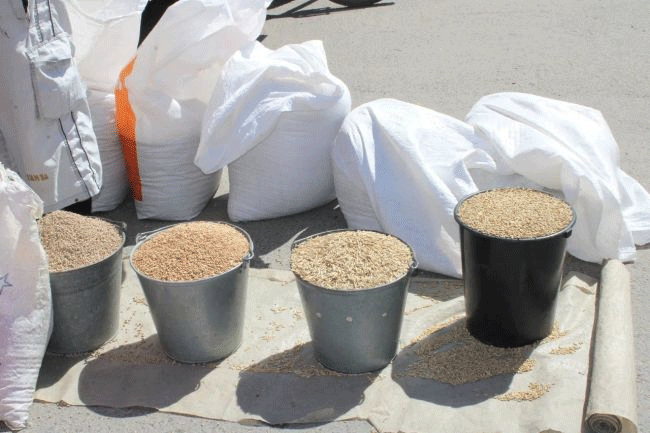
The Tula region has officially crossed a monumental threshold, harvesting over two million tonnes of grain in the 2023 season. This achievement highlights exceptional yields and efficient harvest operations, with the potato sector also demonstrating impressive results. This article breaks down the data and explores the agronomic strategies behind this success, offering insights for high-performance farming in similar climates.
The Tula Oblast, a key agricultural region in Central Russia, is reporting a landmark harvest for the 2023 season. Governor Dmitry Milyaev announced that the region’s farmers have successfully surpassed the two-million-tonne mark for grain. This impressive feat was achieved with the harvest of grain and leguminous crops completed for 73% of the sown area, indicating that the final volume will be significantly higher.
Beyond grains, the region is excelling in other key crops:
- 130,000 tonnes of rapeseed have been harvested.
- 210,000 tonnes of potatoes have been lifted, representing 27% of the total planted area.
The potato harvest is particularly noteworthy for its extraordinary yield. The regional average currently stands at 44 tonnes per hectare. Even more impressive is the report that several leading farms are achieving yields exceeding 50 tonnes per hectare.
This level of productivity places the Tula region significantly above national averages. According to recent forecasts from the Russian Ministry of Agriculture, the national average cereal yield for 2023 is projected at around 31.2 centners/ha (3.12 t/ha). Tula’s performance, likely well above this average to hit a 2 million+ tonne volume, indicates superior crop management practices. The potato yields are equally remarkable, comparing favorably to leading European producers and far exceeding the global average, which sits closer to 20-25 tonnes per hectare according to FAO data.
This success is not accidental. It is the result of a confluence of factors becoming standard among top-tier agricultural regions:
- Precision Agriculture: The adoption of GPS-guided machinery, variable-rate technology (VRT) for seeding and fertilizing, and drone-based field monitoring allows for optimal resource use.
- Advanced Genetics: The use of high-yielding, disease-resistant seed varieties adapted to the local climate is fundamental.
- Scientific Soil Management: A focus on comprehensive soil health, including tailored fertilizer programs and organic matter management, builds a foundation for high yields.
- Favorable Conditions: While technology is key, cooperative weather patterns during the growing season certainly contribute to such outstanding results.
The Tula region’s harvest results set a new benchmark for agricultural productivity in Central Russia. Surpassing two million tonnes of grain and achieving potato yields of 44-50 t/ha demonstrates what is possible through the integration of modern agronomic science, precision technology, and effective farm management. For farmers and agronomists, Tula’s success serves as a powerful case study: strategic investment in technology and data-driven practices is the primary driver for surpassing production goals and achieving new levels of profitability and sustainability.
Error