Yakutia’s ongoing harvest campaign is setting remarkable records, particularly in grain production, showcasing the potential of high-latitude agriculture. Driven by favorable weather and strategic management, the region is on track to significantly surpass its annual targets. This article breaks down the latest data and explores the implications for sustainable farming in extreme climates.
The Republic of Sakha (Yakutia), one of the most challenging and extreme agricultural regions in the world, is in the midst of a surprisingly bountiful 2023 harvest. According to the regional Ministry of Agriculture, the campaign, which began in early September, is already yielding results that far outpace previous years, signaling a potential breakthrough for food security in the Russian Far North.
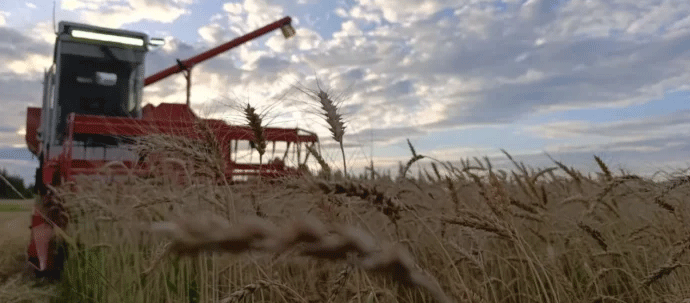
As of the latest report, harvesting is underway in six of the republic’s thirteen districts. The progress is substantial: 39% of the total sown area (4,403 hectares) has already been harvested. The most staggering figure is the grain harvest. Farmers have already threshed 5,699 tonnes of grain, achieving 46% of the annual plan of 12.1 thousand tonnes. This output is more than double (over 108% higher) the volume collected at the same point in 2022, which stood at just 2,732 tonnes. The average grain yield is currently reported at 12.9 centners per hectare (approximately 1.29 tonnes/ha).
The success story extends beyond grain. The potato harvest is also progressing well, with 11,642 tonnes dug from 1,173 hectares (18% of the planned area). The average yield for potatoes is an impressive 99.2 centners/ha (9.92 tonnes/ha). For open-ground vegetables, the yield is even higher at 121.4 centners/ha (12.14 tonnes/ha). In total, 5,351 tonnes of vegetables (18% of the 28.7k tonne plan) have been collected, representing a 21% increase over the previous year. This total includes 1,284 tonnes of open-ground vegetables and 4,067 tonnes from protected ground (greenhouses).
Vyacheslav Gavriliev, Head of the Plant Development Department, attributed this success to a combination of favorable weather conditions and the coordinated work of the region’s agricultural professionals. He confidently stated that the planned targets will not only be met but exceeded, especially for grain.
This impressive performance is not accidental. It aligns with a broader national trend and modern agricultural advancements. According to the Russian Federal State Statistics Service (Rosstat), the application of mineral fertilizers in the Russian Federation has been steadily increasing, a key factor in boosting yields even in less fertile soils. Furthermore, the adoption of climate-resilient crop varieties and precision farming techniques tailored for northern conditions is becoming increasingly critical. Modern seed genetics, focused on developing early-maturing and frost-tolerant cultivars, plays a vital role in mitigating the risks associated with Yakutia’s short growing season and harsh climate.
The 2023 harvest in Yakutia demonstrates a significant agricultural achievement. Doubling grain production compared to the previous year is a powerful indicator of the region’s evolving agricultural capacity. This success is likely a direct result of synergistic factors: investment in modern agronomy, the adoption of resilient technologies, and, crucially, cooperative weather. It serves as a compelling case study for how strategic adaptation and scientific support can unlock the agricultural potential of even the most extreme environments, enhancing regional food sovereignty and offering a model for other northern latitudes facing similar challenges.
Error