In the heart of America’s agricultural belt, a quiet revolution is attempting to take root. Midwest farmers are rediscovering the value of oats – a crop that once dominated Iowa landscapes with over 6 million harvested acres annually until the 1950s. Today, despite mounting evidence of its environmental and agronomic benefits, oat cultivation faces significant structural challenges in a agricultural system optimized for corn and soybeans.
The current state of oat production reveals a stark contrast. While Quaker Oats operates the world’s largest cereal plant in Cedar Rapids, Iowa, the oats fueling that production come primarily from Canada – up to 1,000 miles away. This despite new field trials demonstrating that food-grade oats can be successfully grown in Iowa and Minnesota. The statistics tell the story: Iowa harvested nearly 40,000 acres of oats for grain in 2022, ranking eighth nationally and representing a 12.6% increase since 2017, but this pales in comparison to the millions of acres devoted to corn and soybeans.
The environmental case for oats is compelling. Research from Minnesota shows groundwater under oat acres contains up to 60% less nitrate than under corn acres – a critical finding as the EPA pressures states to address nitrate pollution. The crop’s benefits extend beyond water quality: oats break pest cycles, with soybeans showing up to a 10% yield bump when following oats in rotation. When planted with red clover, oats provide natural nitrogen for subsequent crops, reducing fertilizer requirements and costs.
Yet the infrastructure supporting oat production has languished. Iowa State University, a land-grant institution with a powerhouse agriculture college, hasn’t had an oat breeder since 2007 and doesn’t conduct its own oat trials. As emeritus professor Matt Liebman notes, “Iowa is the donut hole” for oat research, surrounded by states with more active programs. The fundamental challenge is economic: unlike hybrid corn and soybeans, oats don’t require annual seed purchases, making them “much less lucrative” for agricultural companies.
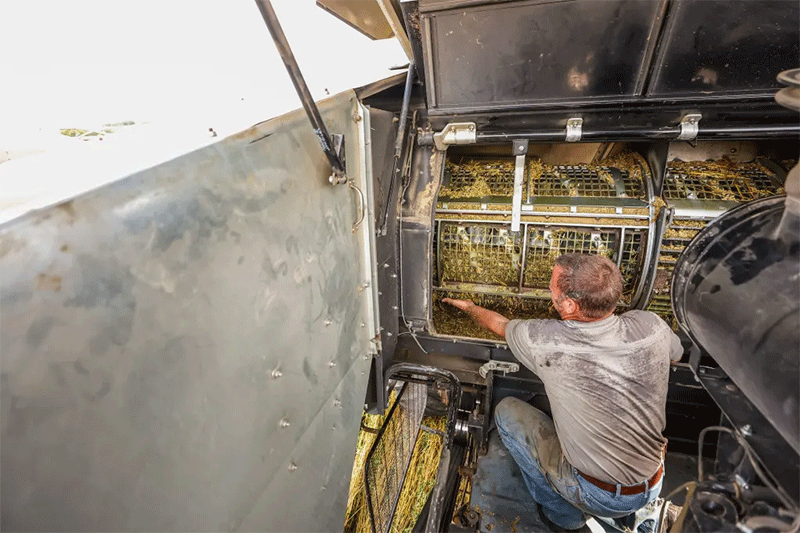
Despite these barriers, farmers are pioneering solutions. Martin Larsen of Minnesota has developed a successful three-crop rotation on 1,400 acres using specialized equipment that strips oat seeds while leaving stalks for erosion control. Meanwhile, Landon Plagge has organized about 70 farmers to invest in Green Acres Milling – a $55 million oat-processing plant in Albert Lea, Minnesota scheduled to open next year. The facility will eventually process 3 million bushels of oats annually, requiring approximately 60,000 oat acres within three years.
Market demand is increasingly favorable. The global oat milk market was valued at over $2 billion in 2020 and continues growing, while consumers show willingness to pay almost 10% more for sustainably-sourced products according to PwC’s 2024 survey. Companies like Seven Sundays have successfully built brands around domestic, sustainably-produced oats, even securing placement in major retailers like Costco.
The Midwest oat renaissance faces a classic chicken-and-egg dilemma: farmers need processing infrastructure and market guarantees to justify expanding production, while processors need reliable supply volumes to justify investment. The solution lies in coordinated effort between forward-thinking farmers, value-added processors, and research institutions willing to reinvest in oat breeding and agronomy. While major agricultural companies may never champion oats with the same enthusiasm as corn and soybeans, the combination of environmental benefits, consumer demand, and economic opportunity for farmers suggests this humble grain has a viable future in the Midwest rotation. The success of farmer-led initiatives like Green Acres Milling may ultimately demonstrate that sustainable agriculture can thrive even without full-throated support from Big Ag.
Error