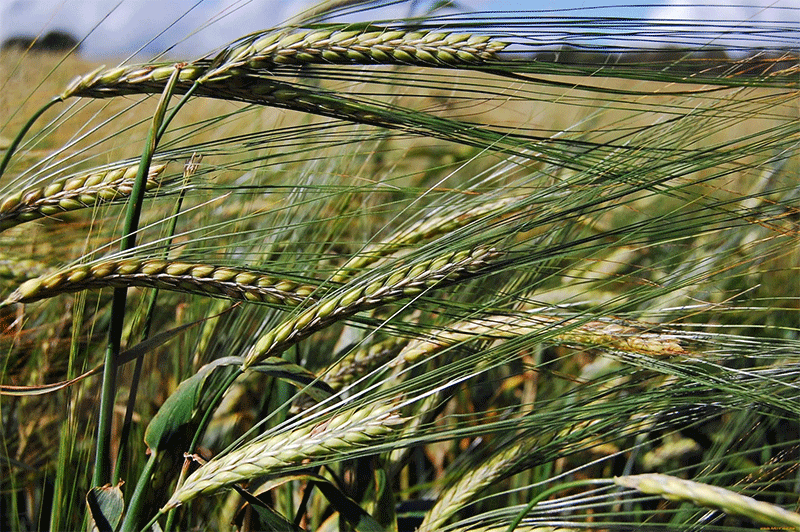
A quiet revolution is unfolding in the fields and bakeries of Russia. Rye, the grain that historically defined Russian bread culture, is rapidly transitioning from a staple commodity to a niche, premium product. This shift is driven by a powerful confluence of collapsing supply and evolving demand, creating a market dynamic unlike any other in the grain sector.
The most immediate factor is a historic collapse in production. As noted in the initial analysis, rye harvests have fallen to a historical minimum due to a sharp, sustained reduction in planted area. This isn’t a one-year anomaly but the culmination of a long-term trend. Data from the USDA Foreign Agricultural Service confirms that Russia’s rye acreage has been in freefall for decades, dropping from over 10 million hectares in the Soviet era to just over 1 million hectares recently. This decline was initially triggered by a decades-long drop in demand for both fodder and food-grade rye, leading farmers to prioritize more profitable crops like wheat.
The laws of economics are now in full effect. With supply at record lows, prices for rye and its processed products are experiencing record growth. Analytical agencies like AB-Center report that the cost of rye flour and rye bread is rising at a pace that significantly outstrips the country’s average inflation rate. This price surge is fundamentally altering the product’s place in the market.
The second, and perhaps more profound, driver is a seismic shift in consumer preferences. Rye bread is no longer a non-negotiable daily staple for the masses. Instead, it is becoming a product for situational, episodic consumption. For a growing segment of consumers, it is now associated with special occasions, rare gastronomic experiences, or the revival of food traditions. This mirrors a global trend identified by the International Food Information Council (IFIC), where consumers increasingly seek out “heritage” and “authentic” grains for their perceived health benefits and cultural value, even at a premium price.
This creates a complex scenario. On one hand, the low supply and high prices present a clear opportunity for the farmers who have stayed with rye or are considering re-introducing it into their rotations, especially on marginal soils where it outperforms wheat. On the other hand, the bakers and food producers who rely on rye now face significantly higher input costs, forcing them to market their products as premium goods to a selective audience.
The story of Russian rye is a classic case of market evolution. It highlights how agricultural landscapes are reshaped by the interplay of production economics and consumer behavior. The grain is not disappearing; instead, it is being revalued and repositioned. For the agricultural sector, this presents a critical choice: continue to view rye as a declining commodity or recognize its new potential as a specialized, high-value crop. The future of rye likely lies not in vast monocultures for mass consumption, but in targeted production for a premium market that values its unique flavor, nutritional profile, and cultural heritage. This pivot requires adaptation from everyone in the value chain, from farmers to retailers, but it also opens the door to improved profitability and a more diverse, resilient agricultural system.