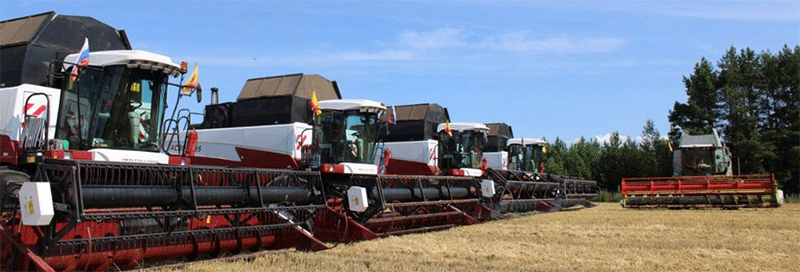
Agricultural producers and experts understand that a bountiful harvest is only the first step in a successful season. The recent reports from the Russian republic of Chuvashia provide a compelling real-time case study of this dynamic. Despite weather-related delays, the region is on track for a historic year, with 661.5 thousand tons of grain already threshed from just over 62% of the planned harvest area.
The most staggering figure is the dramatic increase in productivity. The average grain yield across Chuvashia currently stands at 38.3 centners per hectare (c/ha), a remarkable 33% increase compared to the previous year. This surge in efficiency highlights the significant yield potential that can be unlocked through a combination of improved agronomic practices, favorable weather conditions for crop development, and potentially the adoption of higher-performing varieties.
Regional performance within the republic further illustrates the impact of localized management and conditions. The Krasnoarmeysky and Cheboksary districts have emerged as yield leaders, achieving impressive results of 47.2 c/ha and 44.7 c/ha, respectively. In terms of total volume, the Yalchiksky and Tsivilsky districts are leading the republic, demonstrating that high productivity can be achieved across diverse areas.
However, this abundance brings its own set of challenges. Republic Head Oleg Nikolayev acknowledged that rainfall has slowed the pace of the harvest campaign. This is a familiar dilemma for farmers worldwide: the race to gather a record crop before weather conditions compromise its quality or halt operations entirely. The pressure then immediately shifts to post-harvest logistics, including drying, storage, and transportation, to preserve the value of the high-yielding crop.
Simultaneously, the focus is already turning to the next production cycle. Farmers in Chuvashia have begun sowing the 2024 winter wheat crop, with 12.4 thousand hectares (16.8% of the plan) already completed. The ability to maintain this sowing schedule amidst a delayed harvest is critical for establishing a strong crop that will overwinter successfully and set the stage for next year’s productivity.
The situation in Chuvashia is a microcosm of modern agricultural production. It underscores several key lessons for farmers and agronomists globally:
- Yield Potential is Increasing: Significant year-on-year yield improvements of 30% or more are achievable, highlighting the importance of continued investment in technology, genetics, and precision agronomy.
- Logistics are a Critical Bottleneck: A record harvest can quickly become a liability if the infrastructure for timely harvesting, drying, and storage is not in place. Efficiency must extend beyond the field.
- The Sowing-Harvest Nexus: The harvest of one crop directly impacts the sowing conditions for the next. Effective farm management requires seamless coordination between these two critical seasons to ensure the success of both.
Chuvashia’s record harvest is a testament to agricultural progress, but it also serves as a reminder that productivity is only valuable if it can be efficiently and effectively captured and followed by successful subsequent operations.
Error