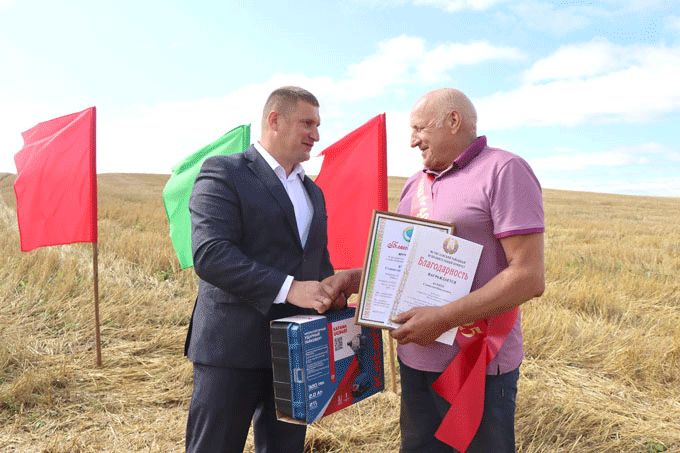
An article celebrating a driver, Stanislav Kurito, for hauling 4,000 tons of grain during the harvest is more than a simple human-interest story. For farm owners, agronomists, and agricultural engineers, it is a compelling data point that offers a window into the scale, efficiency, and logistical complexity of a successful modern harvest operation. This achievement, while rightfully honoring the driver, underscores a sophisticated interplay of machinery, planning, and labor management.
Deconstructing the 4,000-Ton Feat: A Lesson in Logistics
To appreciate this milestone, we must move beyond the total tonnage and analyze the operational efficiency it represents.
- Truck Capacity: A modern MАZ-6501 grain truck with a trailer, as mentioned, typically has a payload capacity of 35-40 metric tons.
- Number of Trips: To haul 4,000 tons, this translates to approximately 100-115 full truckloads.
- Timeframe: Assuming a compressed harvest window of 15-20 days for a single farm’s intense activity, this driver would need to complete 5-7 fully loaded trips per day.
This level of productivity is only possible with near-perfect synchronization. It implies that combines were operating at peak capacity with minimal downtime, the offloading points (the grain接收台 – tok) were free of bottlenecks, and the truck itself was exceptionally reliable. Any significant delay at any point in this chain—a combine breakdown, a line at the dryer, or road congestion—would drastically reduce this number.
The Larger Trend: Capital Intensity and Operational Efficiency
This story is a microcosm of a global trend in agriculture: the shift towards higher capital intensity to combat labor shortages and improve timeliness. The pressure to harvest quickly and efficiently to minimize field losses and maintain grain quality is immense. Data from a 2023 report by the USDA’s Economic Research Service emphasizes that farmers are increasingly investing in higher-horsepower, more reliable equipment and adopting sophisticated logistics software to optimize machine movement across fields. The driver’s achievement is a testament to an operation that has successfully implemented these principles.
The Human Factor in a Mechanized System
While machinery is critical, the human element remains irreplaceable. An experienced driver does more than just drive. They are responsible for:
- Pre-operational checks to prevent mechanical failures on the road.
- Efficient and safe loading/unloading to protect grain quality and equipment.
- Navigating challenging field and road conditions quickly and safely.
Recognizing and incentivizing this skilled labor is crucial for retention and performance. The public recognition and bonuses described are not merely gestures; they are smart business practices that boost morale and encourage the high level of dedication required during the exhausting harvest season.
The celebration of a single driver hauling 4,000 tons of grain is well-deserved. However, for agricultural professionals, the true lesson lies beneath the surface. This achievement is the result of a highly tuned system where agronomic timing, mechanical reliability, and logistical precision converge. It highlights that maximum yield is achieved not only in the genetics of the seed or the fertility of the soil but also in the efficiency of the supply chain moving from the combine to the storage bin. For farm owners and managers, investing in modern, reliable machinery and, just as importantly, in the skilled operators who run them, is a proven strategy for mitigating risk and maximizing profitability during the most critical time of the year.
Error