Tatarstan, one of Russia’s key agricultural regions, is experiencing what local farmers describe as “semi-catastrophic” conditions following record-breaking August rainfall. What began as a promising season with yield projections of 50-60 centners per hectare has deteriorated into a desperate salvage operation, with actual yields now estimated at just 30 centners per hectare in the best cases. The region has received 69 mm of rain since August began—28% above the monthly norm of 54 mm—with some areas exceeding 80 mm, creating conditions that have halted harvesting operations and threatened both crop quality and winter sowing schedules.
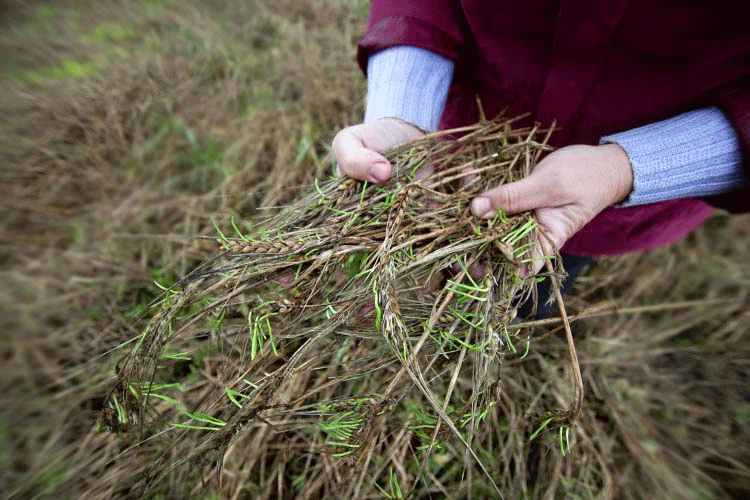
The economic impact is already substantial. According to Tatarstan’s Ministry of Agriculture and Food, harvesting progress has slowed dramatically, with only 226,000 hectares harvested over two weeks—equivalent to just 3-4 days of work under normal conditions. Grain moisture levels have reached 20-26% (well above the 12-14% ideal), forcing farmers to incur additional drying costs while facing significant quality deterioration. The situation has become so severe that some farmers report having to plow under entire fields where grain has sprouted still standing, with individual farm losses estimated at 50 million rubles or more.
The quality implications are equally concerning. Excessive moisture has led to weakened gluten content, reduced protein levels, and widespread grain sprouting in the field—conditions that downgrade much of the harvest to animal feed quality (5th class) rather than human consumption standards (3rd class). According to the All-Russian Research Institute of Phytopathology, grain sprouting in wet conditions can reduce baking quality by up to 40% and promote dangerous mycotoxin development, creating additional food safety concerns.
Despite these challenges, some silver linings emerge. The Ministry reports that 65% of the planned 1.224 million hectares have been harvested, yielding 3.22 million tons of grain at an average of 40.7 centners per hectare—still significantly above last year’s drought-affected yield of 28.5 centners per hectare. Several districts (Kaybitsky, Spassky, Chistopolsky, and Alkeyevsky) have completed over 80% of their harvesting, demonstrating that strategic management can partially mitigate weather impacts. Additionally, meteorologists predict a clearing trend with temperatures rising to 25-27°C over the weekend, offering a critical window for final harvesting operations.
Tatarstan’s weather crisis underscores the increasing vulnerability of modern agriculture to climate volatility. The region’s experience demonstrates that even advanced agricultural systems remain highly susceptible to extreme weather events, with cascading effects on yield, quality, and economic viability. For farmers and agricultural professionals, this situation highlights several critical needs: improved water management infrastructure, more resilient crop varieties, enhanced drying and storage capacity, and better risk management tools. The event also illustrates the importance of regional cooperation and flexible harvesting strategies that can capitalize on brief weather windows. As climate patterns become increasingly unpredictable, developing adaptive capacity and resilience will be essential for agricultural sustainability. Tatarstan’s challenging season serves as both a warning and a learning opportunity for agricultural regions worldwide facing similar climate-related challenges.
Error