The agricultural landscape of Kyzylorda Oblast is poised for a significant transformation. Regional authorities, led by Akim Nurlbek Nalibayev, are in advanced discussions with the founders of the “Zharkent Starch and Syrup Plant” to establish a deep-processing facility for corn. This move represents a strategic shift from primary production to value-added agribusiness, directly impacting the economics of farming in the region.
The proposed plant would utilize local corn to produce high-demand commodities such as starch and syrup. This model is based on the successful example of the Zharkent plant, whose operations and technology the delegation from Kyzylorda recently studied. The focus is on locating the new facility near key corn-growing areas—Zhalagash, Syrdarya, Shiely, and Zhanakorgan districts—to minimize logistics costs and create a direct, reliable market for local producers.
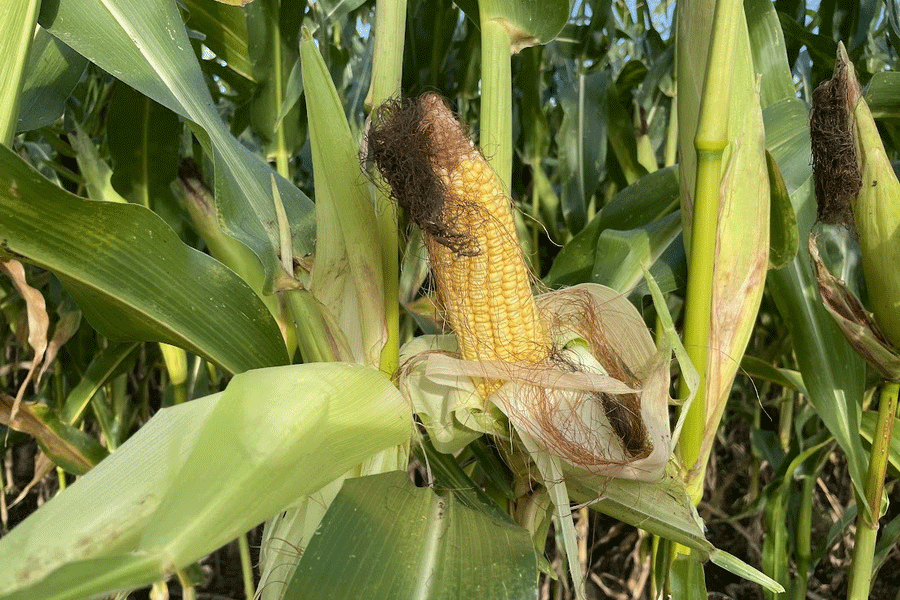
This initiative is backed by concrete growth in raw material supply. According to the regional akimat, the area under corn cultivation has seen a notable 20% year-over-year increase, reaching 2,490 hectares in the current year. This expansion is part of a broader state-mandated goal to double agricultural output, with a specific focus on moisture-preserving crops like corn, which are well-suited to the region’s conditions. With 286,000 hectares of irrigated land, of which 178,600 are systematically rotated, Kyzylorda possesses a strong foundation for scaled agricultural production.
The project is receiving full governmental support. A special working group is already addressing critical infrastructure needs, including engineering, rail access, and environmental permits. State agencies have pledged comprehensive support for investors, covering land allocation, assistance with development financing, and administrative guidance to ensure the project’s viability.
The plan to launch a corn deep-processing plant in Kyzylorda is a forward-thinking strategy that moves beyond commodity exports. By processing corn locally into starch, syrup, and other derivatives, the region can capture significantly more value from each hectare sown. This creates a stable domestic market for farmers, insulates them from global grain price volatility, increases profitability across the supply chain, and contributes to national food security goals. For agronomists and farm owners, this signals a future where crop selection is increasingly driven by local industrial demand, promising greater economic stability and incentivizing further efficiency gains in production.
Error