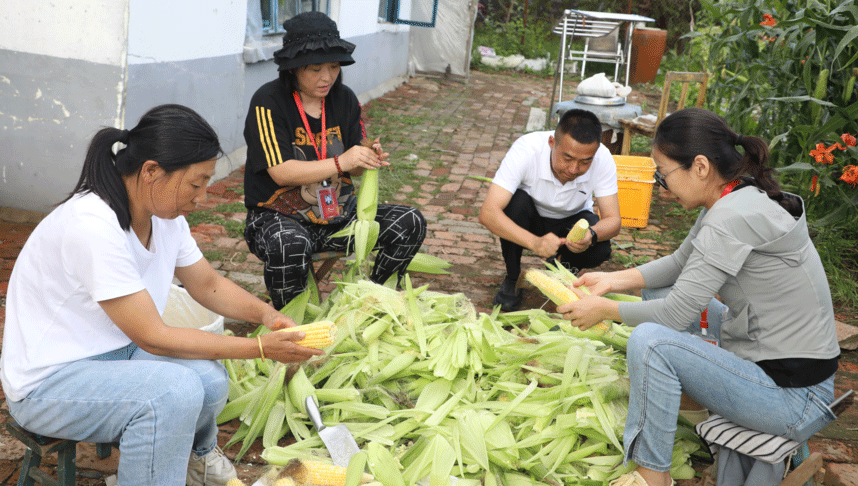
The remarkable expansion of waxy corn (Zea mays L. ceratina) production in Xunke County’s Qike Town represents a compelling case study in agricultural diversification and rural economic resilience. From humble beginnings of scattered plantings before 2000, the area dedicated to this specialty crop has grown tenfold, from approximately 30 acres to 300 acres. Today, over 95% of households in Sixin Village participate in cultivation, driven by strong market demand and effective support systems. This growth underscores a global trend where farmers are increasingly turning to high-value, niche crops to boost profitability and mitigate the risks associated with commodity markets.
The journey of farmers like Han Xuejiao, who expanded her plot from 3 acres in 2021 to 10 acres in 2025, illustrates the power of continuous learning and varietal improvement. Her focus on enhancing “taste and quality” through improved planting techniques and superior genetics mirrors broader agricultural advancements. Globally, the sweet corn seed market itself is projected to grow from $815 million in 2025 to $992 million by 2031, reflecting rising consumer demand for high-quality maize products. This growth is fueled by genetic innovations, including climate-resilient hybrids developed through marker-assisted selection and CRISPR-Cas9 editing, which enhance traits like sweetness, pest resistance, and abiotic stress tolerance.
The Power of Community and Institutional Support
A critical factor in Xunke’s success is the synergistic support from local institutions and community cooperation. The village’s驻村工作队 (resident work team) played an indispensable role by providing hands-on labor during harvest and, crucially, developing innovative market linkages for elderly or resource-limited farmers. This included leveraging personal networks for direct sales and connecting producers with institutional buyers in urban areas, ensuring stable prices and reducing post-harvest losses. This model of support aligns with a key trend in agricultural economics, where investment in rural infrastructure and community-based extension services is proven to enhance productivity and inclusivity.
Strategic Agronomy and Sustainable Practices
The agronomic choices in Sixin Village are deliberate and data-informed. Farmers primarily cultivate varieties like Huangnian 5, 1002, and Nongkeyu 336, selected for their adaptability and quality. This focus on optimized genetics is a cornerstone of modern production. Furthermore, the practice of steaming and fresh-marketing locally adds value and minimizes the need for complex storage, a smart strategy for a perishable product. This echoes global research emphasizing that tailored agronomic practices—including precision nutrient management and optimized planting configurations—are essential for maximizing yield and quality in sweet corn production systems.
The county’s ambition to become a “sweet corn characteristic village” highlights the strategic shift towards specialized agricultural economies. This is not an isolated phenomenon. Regions like Chile’s Central Valley have achieved global dominance in fruit exports by leveraging their unique climates and adopting precision agriculture technologies, which over 60% of farms now use to optimize resources. Similarly, Xunke’s plan to “guide farmers in developing diversified economic crops” is a pathway to enhanced resilience, much like the integrated and sustainable value chains being promoted worldwide.
Market Dynamics and Economic Impact
The economic impact is tangible. A single farmer can sell over a thousand ears in a day at favorable prices, indicating robust local demand and efficient distribution. This successful commercialisation transforms a traditional crop into a significant income source. This mirrors the global sweet corn seed market’s growth, driven by its use in food processing, biofuels, and animal feed. The model of fetching a premium for a fresh, high-quality product directly to consumers is a powerful example of value capture at the farm gate.
Xunke County’s waxy corn story is more than a local success; it’s a blueprint for sustainable agricultural development. Its lessons are universal: identify a suitable niche crop, invest in continuous learning and improved genetics, foster strong community and institutional support, and implement smart agronomy and market-linked strategies. For farmers worldwide, this case demonstrates that profitability often lies in diversification, quality enhancement, and building resilient local value chains rather than solely pursuing scale in commodity production. The future of such industries will likely be shaped by further integrating precision agriculture tools, climate-resilient varieties, and transparent traceability systems to access premium markets and ensure long-term sustainability.
Error