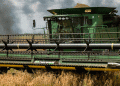
The 2025 harvest in Orlovsky Oblast is a tale of two extremes: unprecedented field productivity tempered by challenging weather that is pushing post-harvest management to its limits. While combines are rolling out record-breaking numbers, they are often collecting grain with dangerously high moisture content, creating a critical bottleneck that could undermine the quality of an otherwise bumper crop. According to reports from the field, the region has already threshed nearly 2 million tonnes of grain and oilseed, with an average yield soaring to 53.4 centners per hectare (5.34 t/ha)—a significant increase of 7.1 c/ha over the previous year.
The yield data is nothing short of spectacular. Alexander Yushin, General Director of “Khleborob” LLC, reported historic results for his operation: 89.6 c/ha (8.96 t/ha) for winter wheat and 85.4 c/ha (8.54 t/ha) for barley, alongside an excellent yield of 58.3 c/ha (5.83 t/ha) for winter rapeseed. These figures far exceed not only the regional average but also Russia’s national projected yield, which analysts like IKAR often estimate at around 3.2 t/ha for wheat. Such performance places Orlovsky farms at the forefront of agricultural productivity in the country.
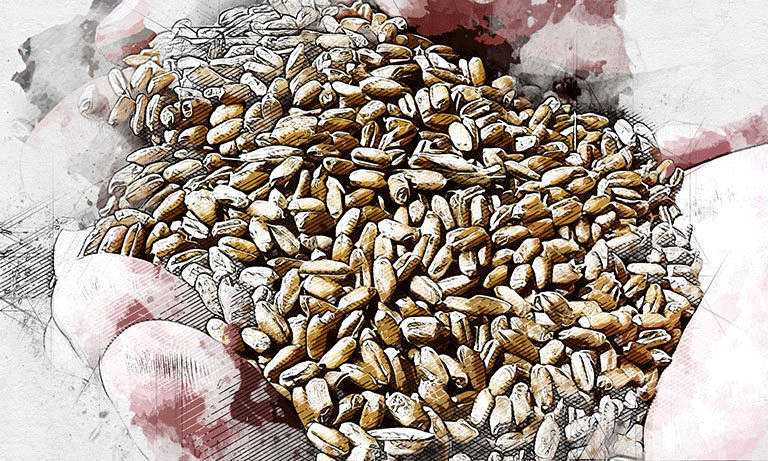
However, these stellar yields are under threat from persistent rainfall. The pace of harvest is lagging behind last year’s, and the grain is being collected “raw.” This presents a severe risk of spoilage, mold, and mycotoxin development if not managed immediately. Yushin’s comment that a “new dryer is saving us” highlights the absolute necessity of robust, high-capacity drying infrastructure in the face of climate volatility. This aligns with a growing global focus on post-harvest loss prevention; the FAO estimates that inadequate drying and storage can lead to losses of 10-20% of total grain production in developing regions, a risk that now clearly extends to major producers like Russia.
Compounding the logistical challenge is market pressure. While prices for rapeseed (~40,000 RUB/tonne) and barley (~17,100 RUB/tonne) are favorable, the price for high-quality wheat is currently perceived as low at ~14,000 RUB/tonne. This creates a financial squeeze where the cost of energy-intensive drying must be carefully weighed against the potential for price appreciation later in the season.
The situation in Orlovsky Oblast is a powerful case study in modern agricultural management. It demonstrates that achieving genetic and agronomic potential in the field is only half the battle. Climate change is increasing the frequency of harvest-time rain events, making investment in post-harvest infrastructure—particularly high-capacity, energy-efficient grain dryers—not a luxury, but a necessity for preserving quality and value. For farm owners and managers, this season underscores the critical need to balance agronomic excellence with equally sophisticated logistics and market strategy to protect profitability from the field to the bin to the market.
Error