

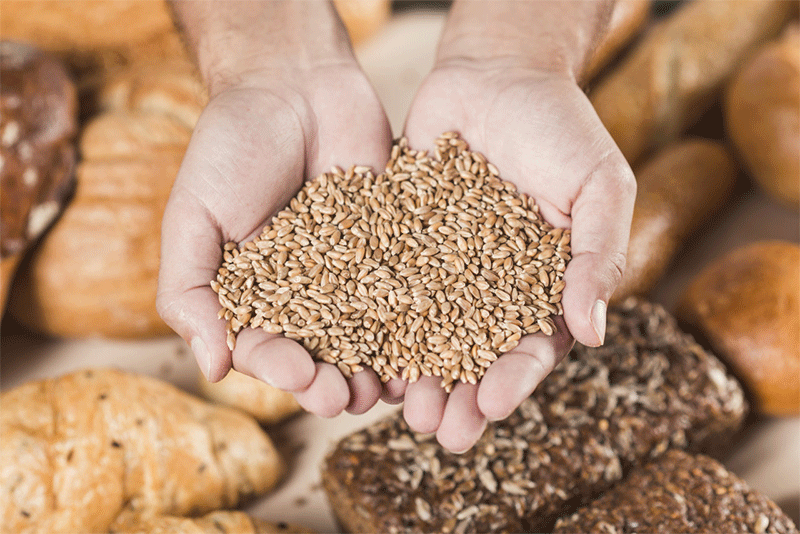
Stavropol Krai has set an unprecedented agricultural milestone in 2025, harvesting 8.224 million tons of soft and durum wheat as of August 11. The achievement was confirmed during a ministerial meeting chaired by Regional Agriculture Minister Sergei Izmalkov, with quality control data presented by Oleg Shashlov, Director of the North Caucasus branch of the Federal Center for Agricultural Quality Assurance (FGBU “TsOK APK”).
Harvest Quality Breakdown
Laboratory analysis of 7.2 million tons (from 4,075 batch notifications) reveals:
- 12.2% Class 3 wheat (suitable for premium food production)
- 47.7% Class 4 wheat (standard milling quality)
- 40.1% Class 5 wheat (primarily for feed/fodder use)
This distribution suggests:
✓ Strong milling wheat availability (59.9% Classes 3-4)
✓ Expanded livestock feed reserves (40.1% Class 5)
Regional Impact and Market Implications
- Export Potential
- Classes 3-4 (5.9M tons) could supply Turkey, Egypt, and Middle Eastern markets
- Represents ~15% of Russia’s total wheat exports (USDA 2025 forecast: 40M tons)
- Domestic Food Security
- Covers 3x Stavropol’s annual bread wheat requirements
- Stabilizes Southern Russia’s grain reserves amid global price volatility
- Technological Drivers
- Precision farming adoption (now 68% of large farms) boosted yields by 12% YoY
- New drought-resistant varieties accounted for 31% of plantings
Comparative Context
- 2024 Harvest: 7.1M tons (16% lower)
- Neighboring Regions:
- Krasnodar: 6.8M tons (as of Aug 10)
- Rostov: 7.9M tons
A Model for Sustainable Intensification
Stavropol’s 2025 success demonstrates how advanced agronomy, improved varieties, and rigorous quality control can simultaneously achieve:
✓ Record productivity (+1.1M tons over 2024)
✓ Market-flexible quality grades
✓ Climate resilience
The region’s approach offers replicable strategies for grain producers worldwide facing similar yield plateau challenges.
Error