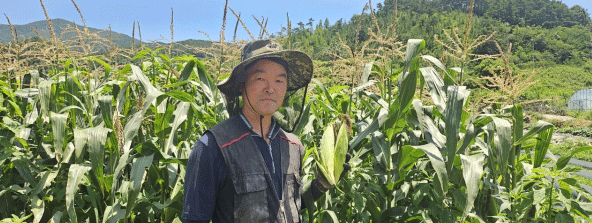
Jeollanam-do has selected organic corn from Suncheon as its “Eco-Friendly Agricultural Product of July.” Corn is rich in antioxidants like beta-carotene, lutein, and zeaxanthin, which help remove free radicals and enhance immune function. It is also high in dietary fiber, improving gut health and digestion, making it a perfect summer snack.
From Conventional to Organic: A Farmer’s Journey
Lim Seok-joong (born in 1973), an organic corn farmer in Suncheon’s Songgwang-myeon, began eco-friendly farming in 2010 after returning to rural life. Starting with pesticide-free certification, he continuously improved his methods, achieving full organic certification in 2021. His dedication to stricter farming practices has paid off—both financially and environmentally.
Impressive Production & Economic Impact
- Current production: 22 tons annually on 6,088㎡ of land.
- Sales channels: Supplied entirely to school meals and agricultural cooperatives.
- Annual income: Approximately ₩100 million (about $77,000 USD).
Lim explains, “I could have stopped at pesticide-free farming, but I wanted to deliver truly organic produce to consumers. Even with experimental farming techniques that sometimes reduced yields, the long-term benefits—higher productivity with less labor—were worth it.”
Suncheon’s Growing Organic Corn Industry
- Total eco-friendly corn production area: 9,848㎡
- Participating farms: 9
- Annual output: 25 tons, fully distributed to schools and cooperatives.
The Future of Organic Farming in Korea
The success of organic corn in Jeollanam-do highlights the growing demand for sustainable agriculture. Farmers like Lim Seok-joong prove that transitioning to organic methods, despite initial challenges, can lead to higher profitability and environmental benefits. With increasing consumer interest in healthy, eco-friendly food, Korea’s organic farming sector is poised for further growth.
Error