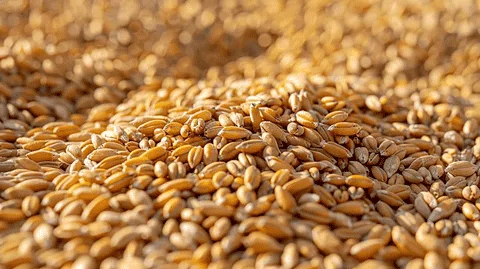
Sucha Singh Pabla, a former corporate manager in Abu Dhabi, has proven that organic farming can be both environmentally sustainable and highly profitable. At 70, Pabla manages 32 acres in Sherpur Bet, Punjab, where he cultivates organic wheat, vegetables, and paddy—earning ₹7 lakh from 200 quintals of wheat alone this year. His secret? Avoiding chemical inputs entirely, relying instead on vermicompost and natural farming techniques.
Higher Prices, Lower Costs: The Economics of Organic Wheat
While conventional wheat farming in Punjab yields 20-22 quintals per acre, Pabla’s organic fields produce 14-15 quintals. However, his wheat sells at ₹3,500 per quintal—far above the standard ₹2,425—attracting buyers from Punjab, Himachal Pradesh, and Haryana. According to a 2023 report by the Indian Council of Agricultural Research (ICAR), organic wheat commands a 20-30% price premium in domestic markets due to rising health consciousness. Additionally, Pabla’s input costs are minimal, as he produces his own vermicompost and avoids synthetic fertilizers.
Beyond Wheat: Diversification and Sustainable Practices
After the wheat season, Pabla grows organic vegetables and cultivates paddy on a separate 4-acre plot. Crucially, he avoids stubble burning—a major contributor to air pollution in North India. Instead, he reintegrates crop residue into the soil, preserving microbial health. A 2024 study by Punjab Agricultural University (PAU) found that residue incorporation can increase soil organic carbon by 15% over five years, enhancing long-term fertility.
Training the Next Generation of Organic Farmers
Pabla’s journey began in 2015 after returning from Abu Dhabi, where he spent two decades in corporate life. He later trained in Israel, learning advanced techniques like polyhouse farming and vermicomposting. Today, he mentors aspiring organic farmers and collaborates with Punjab Agro Industries Corporation to promote sustainable agriculture.
A Model for the Future of Farming
Pabla’s success demonstrates that organic farming is not just an environmental choice but a lucrative business model. With premium pricing, lower input costs, and government support, transitioning to organic methods can benefit farmers economically while restoring soil health and reducing pollution. As demand for chemical-free food grows, his story offers a blueprint for sustainable agriculture in India.
Error