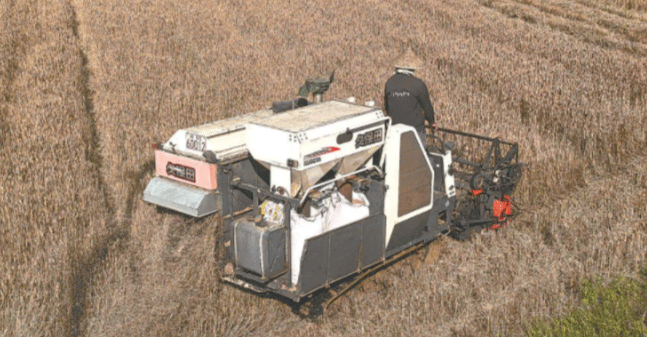
Recently, Dehua County in Fujian Province celebrated the successful harvest of its first large-scale winter wheat trial. Covering 60 mu (about 4 hectares) in Xiaohu Village, Meihu Town, the crop yielded over 300 kg per mu—a significant achievement for a region traditionally limited to single-season rice farming.
From Fallow Fields to Productive Winters
Historically, Xiaohu Village only cultivated rice, leaving fields idle after autumn harvests. However, last November, local farmers introduced winter wheat as a second crop, employing an integrated “chemical + agricultural pest management” approach. After six months of careful cultivation, the trial proved successful, with yields comparable to those in major wheat-producing regions.
Globally, wheat yields average around 3.5–4 metric tons per hectare (approx. 233–267 kg/mu), making Dehua’s 300 kg/mu yield competitive. China’s national wheat productivity has been rising, reaching 5.7 metric tons per hectare (380 kg/mu) in 2023, according to the National Bureau of Statistics. While Dehua’s output is slightly below this, it marks a strong start for a non-traditional wheat-growing area.
Expansion Plans and Economic Potential
Encouraged by these results, Xiaohu Village plans to expand winter wheat planting to 100 mu this year. This shift could boost local incomes and improve land use efficiency—a critical goal as China seeks to enhance food security amid shrinking arable land.
Similar double-cropping systems have succeeded elsewhere. In Sichuan and Henan, integrating wheat with rice or corn has increased annual yields by 20–30%. Dehua’s experiment suggests that even mountainous regions can adopt such models with proper agronomic support.
Key Takeaways for Farmers and Agronomists
- Winter wheat can effectively utilize fallow periods, adding value to single-crop systems.
- Integrated pest management (chemical + agricultural controls) is vital for success in new climates.
- Scalability depends on local conditions, but initial yields of 300 kg/mu show strong potential.
Dehua’s winter wheat breakthrough demonstrates how innovative crop rotations can maximize land productivity, particularly in regions with long fallow seasons. With further refinement—such as optimized varieties and precision farming—this model could benefit farmers across southern China and beyond.
Error