• About
  • Advertise
  • Careers
  • Contact
Friday, January 30, 2026
  • Login
No Result
View All Result
Field Crops news
  • Home
  • News
  • AgroTech & Innovation
  • Science
  • Sustainability
  • Market News
  • Research & Development
  • Home
  • News
  • AgroTech & Innovation
  • Science
  • Sustainability
  • Market News
  • Research & Development
No Result
View All Result
Field Crops news
No Result
View All Result
Home Climate

Balancing Rice Prices: Challenges and Solutions for Farmers and Consumers

by Tatiana Ivanova
18 June 2025
in Climate, News
0
Balancing Rice Prices: Challenges and Solutions for Farmers and Consumers
0
SHARES
4
VIEWS
Share on FacebookShare on Twitter

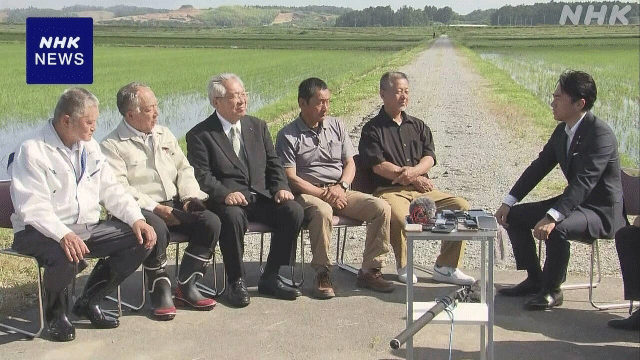
Recent discussions between Japan’s Agriculture Minister, Tetsuro Nomura, and rice producers in Fukushima have highlighted growing tensions over soaring rice prices. Farmers argue that agricultural policies need fundamental changes, while the government seeks to stabilize prices to prevent consumer backlash.

The Rising Cost of Rice: A Global Concern

Japan is not alone in facing rice price volatility. According to the FAO Rice Price Index (May 2024), global rice prices have surged by 14% year-on-year, driven by climate disruptions, rising input costs, and export restrictions in major producing countries like India and Thailand. In Japan, domestic rice prices have jumped 10-15% in the past year, straining both farmers and consumers.

Government Measures: Stock Releases and Policy Revisions

Minister Nomura announced plans to release reserve rice stocks to curb price hikes, a strategy also employed by other Asian nations like the Philippines and Indonesia. However, farmers argue that long-term solutions—such as subsidies for production costs and revised yield statistics—are needed.

Farmer Perspectives: Sustainability vs. Affordability

The Japan Agricultural Cooperatives (JA) emphasized that prices must be “acceptable to both producers and consumers.” Yet, with production costs rising by 20% (MAFF 2024), small-scale farmers struggle to break even. Meanwhile, consumers, facing inflation, are reducing rice purchases—a trend that could harm long-term demand.

Revising Yield Data: A Step Toward Transparency

Criticism over inaccurate government yield statistics has prompted a review. Accurate data is crucial for predicting supply, preventing speculation, and ensuring fair pricing. South Korea and China have implemented AI-driven crop monitoring—a potential model for Japan.

A Delicate Balance for the Future

Stabilizing rice prices requires a multi-faceted approach:

  • Short-term: Release reserves to ease immediate price pressure.
  • Medium-term: Revise policies to support farmers without overburdening consumers.
  • Long-term: Invest in precision agriculture and supply chain resilience to mitigate climate and market risks.

The challenge lies in aligning farmer livelihoods with consumer affordability—a balance that will define Japan’s agricultural future.


Error
Tags: Agricultural Economicsagriculture policyAgronomyClimate Resiliencecrop yieldsFarmersfood securityJapan farmingRice pricessustainable agriculture

Tatiana Ivanova

Next Post
Cheongja No. 5’ Black Soybean: A High-Profit Crop Revolutionizing Paddy Field Diversification

Cheongja No. 5’ Black Soybean: A High-Profit Crop Revolutionizing Paddy Field Diversification

Newsletter

Late Sowing in December and January? PAU Recommends Specialized Wheat Varieties for Optimal Yield

Late Sowing in December and January? PAU Recommends Specialized Wheat Varieties for Optimal Yield

12 December 2024

Ethiopia’s Wheat Self-Sufficiency Claims Amid Ongoing Food Insecurity

22 February 2025

AirAgri: Innovating Farm Safety with Technology

28 June 2024

74.3 Million Mu of Winter Wheat Harvest Begins in Shache County: How High-Yield Varieties and Mechanization Boost Farm Productivity

30 June 2025

Russia’s Wheat Export Boom to Africa: Key Trends, Market Shifts, and Future Projections

14 May 2025

Kaliningrad Region Sets Ambitious Goals to Boost Grain and Rapeseed Production

12 September 2024

Japan Buys Korean Rice for the First Time in 25 Years: What It Means for Global Grain Markets

27 April 2025

Revolutionizing Maize Farming: Introducing ZMS721 in Ethiopia

2 October 2024

Russia Slashes Grain Export Duties: What the 17% Drop in Wheat Tariff Means for Global Markets and Domestic Producers

24 April 2025

Southern Rust in Corn: A Growing Threat to Yields and How to Combat It

24 May 2025
  • About
  • Advertise
  • Careers
  • Contact
Call us: +51 93 999 5140

© 2020-2024 Field Crops news

Welcome Back!

Login to your account below

Forgotten Password?

Retrieve your password

Please enter your username or email address to reset your password.

Log In
No Result
View All Result
  • Home
  • News
  • Science
  • Sustainability
  • AgroTech & Innovation
  • Market News
  • Science
  • Research & Development
  • About
  • Contact

© 2020-2024 Field Crops news