• About
  • Advertise
  • Careers
  • Contact
Saturday, December 13, 2025
  • Login
No Result
View All Result
Field Crops news
  • Home
  • News
  • AgroTech & Innovation
  • Science
  • Sustainability
  • Market News
  • Research & Development
  • Home
  • News
  • AgroTech & Innovation
  • Science
  • Sustainability
  • Market News
  • Research & Development
No Result
View All Result
Field Crops news
No Result
View All Result
Home Market News

Rice Glut in Krasnodar: Falling Prices, Export Challenges, and the Future of Russia’s Rice Industry

by Tatiana Ivanova
16 June 2025
in Market News, News
0
Rice Glut in Krasnodar: Falling Prices, Export Challenges, and the Future of Russia’s Rice Industry
0
SHARES
6
VIEWS
Share on FacebookShare on Twitter

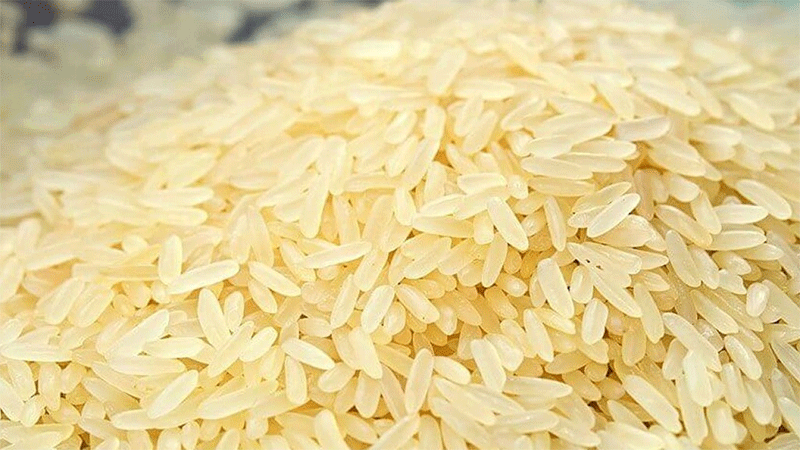
As of early June, Krasnodar Krai—Russia’s key rice-producing region—holds 300,000 tons of unsold rice and rice groats, according to Igor Lobach, Chairman of the National Rice Union. This surplus is expected to grow further by the new harvest season, pushing prices down to 22-26 RUB/kg ($0.25-$0.30/kg) for paddy rice, a sharp drop from the 32-36 RUB/kg ($0.37-$0.42/kg) seen over the past 18 months.

Lobach describes the market as “frozen,” with sales nearly halted. The situation stems from export restrictions imposed in 2022 after the Fedorov Hydro Complex accident, which reduced planting areas and yields. Despite a record 2023 harvest of 1.2 million tons, domestic processing capacity (1.5 million tons) remains underutilized, complicating efforts to clear stockpiles.

Export Challenges and Policy Responses

Before the restrictions, Krasnodar exported 180,000–250,000 tons of rice annually, but shipments in early 2024 totaled just 23,500 tons. The Russian government aims to boost production to 2 million tons by 2030, but current market conditions discourage expansion.

To alleviate the crisis, the Ministry of Agriculture plans to introduce a 50,000-ton export quota for rice groats by mid-2024. However, Vice Prime Minister Dmitry Patrushev has ruled out lifting restrictions on paddy rice exports, citing insufficient domestic processing capacity.

Global Context and Future Outlook

Globally, rice prices remain volatile due to climate disruptions in Asia and trade restrictions in India, the world’s top exporter. If Russia reopens exports strategically, it could capitalize on rising demand in Africa and the Middle East, where imports are projected to grow by 4% annually (FAO, 2024).

Krasnodar’s rice surplus highlights the need for balanced stock management and smarter trade policies. While short-term quotas may help, long-term solutions—such as expanding export markets, improving processing efficiency, and stabilizing domestic prices—are crucial for sustaining profitability. Farmers and policymakers must collaborate to avoid future gluts and ensure the sector’s growth aligns with global opportunities.

Error

Tags: Agribusinessagricultural exportsagricultural policyCrop Managementfarm economicsKrasnodar AgricultureRice MarketRice Production

Tatiana Ivanova

Next Post
Russia’s Rice Export Strategy: Balancing Domestic Needs and Global Opportunities

Russia’s Rice Export Strategy: Balancing Domestic Needs and Global Opportunities

Newsletter

Australian Grain Market Trends: Price Movements and Regional Insights for July 2024

Australian Grain Market Trends: Price Movements and Regional Insights for July 2024

12 July 2024

Revolutionizing Farming: The Launch of CLAAS Connect

2 October 2024

Precision to Plate: How Qingdao’s Tech-Driven “Green Grain Increase” is Reshaping Cereal Production

3 October 2025

Strategic Expansion in Agri-Business: ASA Group’s Acquisition of Serbia’s Zito Backa Mill Strengthens Regional Dominance

11 July 2025

India’s Rabi Season Shifts: Wheat and Pulses Surge Amid Changing Sowing Patterns

12 December 2024

Australia’s Canola Export Surge: A Look at May 2024’s Market Trends

12 July 2024

Zero Tariffs, Record Wheat Imports: Vietnam’s Feed Industry Gains—But at What Risk?

18 April 2025

Karan Manjari: The New Wheat Variety Redefining Water-Efficient Productivity in India

28 October 2025

Bitter Beans in Ghana: The Curse of Gold and the Struggles of Cocoa Farmers

29 November 2024

Microbial inoculants improved wheat drought tolerance

8 July 2024
  • About
  • Advertise
  • Careers
  • Contact
Call us: +51 93 999 5140

© 2020-2024 Field Crops news

Welcome Back!

Login to your account below

Forgotten Password?

Retrieve your password

Please enter your username or email address to reset your password.

Log In
No Result
View All Result
  • Home
  • News
  • Science
  • Sustainability
  • AgroTech & Innovation
  • Market News
  • Science
  • Research & Development
  • About
  • Contact

© 2020-2024 Field Crops news