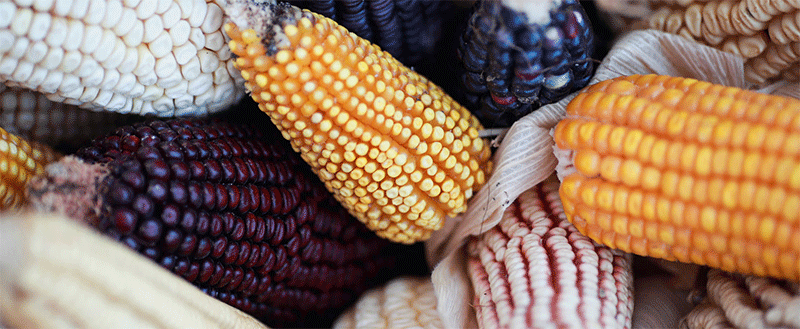
Last winter, as seasonal produce returned to markets in Jaipur, India, I noticed an unsettling absence. Despite visiting countless vendors, desi bhutta, the local Indian corn I grew up eating, was nowhere to be found. In its place stood rows of shiny, sweet, and standardized American corn.
This small, local loss reflects a much larger, global phenomenon: the gradual extinction of native crops and the growing homogenization of our food systems.
The Shrinking Genetic Pool of Global Agriculture
Humans have historically cultivated over 6,000 plant species for food. Today, just nine crops—wheat, rice, maize, potatoes, soybeans, palm oil, sugarcane, sugar beet, and cassava—account for 66% of total global crop production, according to the UN Food and Agriculture Organization (FAO).
This narrowing of agricultural diversity has profound implications for nutrition, livelihoods, and climate resilience. As native crops vanish, so do the food traditions, ecological adaptations, and cultural identities that have sustained societies for millennia.
The High Cost of Agricultural Standardization
The push for high-yield, uniform crops has systematically eroded biodiversity. While industrial farming boosts short-term productivity, it introduces long-term vulnerabilities:
- Increased susceptibility to pests and diseases (e.g., the 1970-71 Southern Corn Leaf Blight in the U.S.).
- Lower nutritional value—many indigenous crops are richer in micronutrients than modern hybrids.
- Climate vulnerability—monocultures struggle under extreme weather, while native crops often have built-in resilience.
A 2023 study in Nature Food found that over 90% of traditional crop varieties have disappeared in the past century, with one-third of global farmland now dominated by just five crops.
Regional Losses: From India to Africa
India’s Vanishing Heritage
- Once home to over 100,000 rice varieties, India now relies on a handful of high-yield strains.
- Traditional crops like Kattuyanam rice (flood-resistant) and Manipur’s iron-rich black rice are nearly extinct.
- The Green Revolution boosted yields but worsened malnutrition—today, 35.5% of Indian children under five are stunted (NFHS-5).
Mexico’s Fight for Native Maize
- Mexico, the birthplace of corn, is losing heirloom varieties like blue and black corn to GMO strains.
- In February 2025, Mexico’s Congress banned GM corn cultivation, a bold move for food sovereignty.
Africa’s Forgotten Grains
- Ancient grains like teff, millet, and sorghum—drought-resistant and nutrient-dense—are being replaced by water-intensive wheat and maize.
- The Alliance for Food Sovereignty in Africa (AFSA) warns that losing these crops could worsen food insecurity.
The Way Forward: Protecting Biodiversity
- Support Small Farmers – Incentivize the cultivation of indigenous crops through subsidies and fair pricing.
- Seed Banks & Conservation – Expand efforts like the Svalbard Global Seed Vault to preserve genetic diversity.
- Consumer Awareness – Promote demand for traditional foods through education and local markets.
- Policy Changes – Governments must enforce biodiversity protection laws, as seen in Mexico’s GM corn ban.
A Call to Action
The loss of native crops is not just an agricultural issue—it’s a threat to global food security, cultural heritage, and ecological balance. Farmers, agronomists, and policymakers must act now to revive traditional crops before they vanish forever.
As climate change accelerates, diversity is our best defense. The future of food depends on what we save today.
Error