As Nigeria seeks to reduce its reliance on rice imports and improve food security, Jigawa State is positioning itself as a national leader in rice production. Governor Umar Namadi, during a recent meeting with officials from the Revenue Mobilization Allocation and Fiscal Commission (RMAFC), announced that Jigawa aims to produce 3.6 million metric tons of rice annually by 2030—equivalent to nearly 50% of Nigeria’s total rice consumption needs.
A Multi-Year Strategy Anchored in Expansion and Innovation
Governor Namadi detailed the state’s agricultural strategy, which includes:
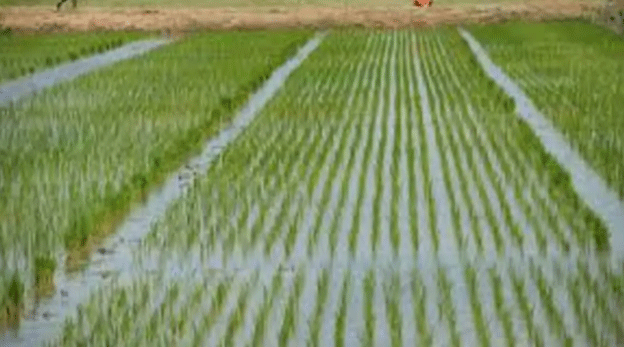
- Cultivating over 250,000 hectares of rice in 2025, up from 200,000 hectares in 2024.
- Doubling that figure to 500,000 hectares by 2030, supported by improved irrigation and mechanization.
- Leveraging biannual rice cultivation cycles—dry and wet seasons—to maximize yield potential.
He emphasized that 85% of Jigawa’s population is engaged in agriculture, underscoring the sector’s central role in the state’s economy and development priorities.
Transforming Arid Lands Through Irrigation
A cornerstone of Jigawa’s plan is the expansion of irrigation infrastructure, which is already producing remarkable results. Governor Namadi shared that for the first time, dry-season farming is now taking place in previously desert-prone regions. These efforts have reversed rural-to-urban migration trends by enabling young people to engage in year-round, productive farming in their home communities.
This transformation is aligned with Nigeria’s broader national agenda to boost climate-resilient agriculture and reduce dependency on food imports. According to the Nigeria Bureau of Statistics (NBS), Nigeria imported over 2.1 million metric tons of rice in 2022. By 2030, Jigawa alone could replace a significant portion of that volume with domestic production.
Leadership Beyond Rice
While rice is the flagship crop in this initiative, Jigawa is also a powerhouse in other agricultural sectors:
- Sesame seed and hibiscus flower: Jigawa is Nigeria’s top producer, contributing over 75% of the nation’s non-oil agricultural exports.
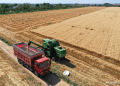
- Wheat cultivation: In 2024, Jigawa planted 55,000 hectares, with a target of 105,000 hectares in 2025—positioning it as a leader in Nigeria’s domestic wheat supply strategy.
These achievements are attracting attention from federal agencies, including the RMAFC, which is assessing states for eligibility under a special 1.68% revenue allocation earmarked for economic diversification through agriculture, tourism, and solid minerals.
Jigawa’s drive to produce 3.6 million metric tons of rice annually is more than a state-level ambition—it’s a blueprint for how targeted investment, irrigation, youth engagement, and visionary leadership can transform a region into an agricultural powerhouse. If successful, Jigawa won’t just feed Nigeria—it will redefine the possibilities for sustainable, scalable farming in West Africa.
Error