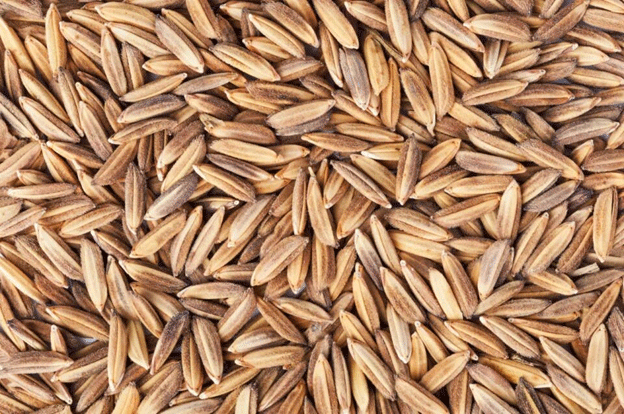
In a strategic move to ensure national food security and stabilize the domestic grain market, Russia’s Government Sub-Commission on Customs-Tariff and Non-Tariff Regulation has extended its ban on the export of rough rice (paddy rice) until December 31, 2025. This decision, published on the official website of the Ministry of Economic Development, highlights the state’s continued focus on controlling grain flows amid global food market volatility.
The ban specifically applies to unprocessed, unhusked rice—the raw form that undergoes hulling before it is suitable for consumption or further processing. However, seed rice remains exempt from the restriction, supporting domestic planting and genetic renewal efforts.
In addition to the ban, the sub-commission introduced a tariff quota for the export of husked (milled) rice and rice groats from Russia to countries outside the Eurasian Economic Union (EAEU). The quota has been set at 50,000 metric tons for the 2025 calendar year. Within this quota, the export duty rate will be 0%, providing an incentive for exporters to stay within permitted volumes. Exports exceeding the quota will be subject to a steep 50% export tariff, effectively discouraging larger volumes and protecting internal supply.
According to Rosstat, Russia produced approximately 1.05 million metric tons of rice in 2023, with forecasts for 2024 estimated around 1.1 million metric tons, depending on weather conditions and water availability in key production regions such as Krasnodar Krai and Astrakhan Oblast.
The government has also initiated a review on the long-term export prospects for processed rice beyond 2025. This will include considerations of annual production volumes, particularly whether harvests consistently exceed 1.1 million metric tons—a threshold that could support sustainable exports without compromising domestic food security. A final decision on this matter is expected during the third quarter of 2025.
Implications for Stakeholders:
- Russian rice producers may benefit from stable domestic pricing and reduced international competition in the raw rice market.
- Processors and exporters have a clear framework to plan export operations within the 50,000-ton quota, avoiding the costly out-of-quota tariffs.
- Farmers are encouraged to monitor government decisions closely, as future export opportunities for processed rice could depend on collective yield performance.
- Importing countries, particularly those previously relying on Russian paddy rice, will need to adjust sourcing strategies and possibly look toward alternative suppliers such as India, Pakistan, or Vietnam.
Russia’s decision to prolong the ban on rough rice exports and impose a quota on processed rice underscores its focus on food security, price control, and strategic resource management. While offering short-term predictability for domestic producers, it also signals to international markets that rice trade flows may continue to shift in response to evolving national policies and production outcomes.
Error