

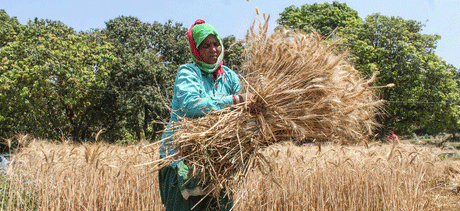
India’s agricultural sector has received a boost this spring, with record wheat and rice reserves reported by the Food Corporation of India (FCI). According to official data, wheat stocks stood at 11.8 million tonnes as of April 1, significantly higher than the buffer norm of 7.46 million tonnes, and 4 million tonnes more than the same period last year.
This surge in stocks reflects a strong harvest season, driven in part by favorable weather patterns during the crop’s maturation stage. Despite above-normal daytime temperatures, cooler-than-expected nights and several rain spells helped mitigate potential heat stress — a growing concern for India’s wheat belt in recent years.
Weather: A Game-Changer for Wheat
Wheat in India is typically sown in November and harvested by April or May. The 2024–2025 season began under the shadow of heatwave warnings, but western disturbances, which are moisture-laden weather systems from the Mediterranean, brought intermittent rains and lower night temperatures, shielding crops during grain filling and ripening.
According to Gyanendra Singh, former director of the Indian Institute of Wheat and Barley Research, “Even if daytime temperatures rise above normal, relatively lower night temperatures provide a shield to wheat crops during its maturing stage. That’s the good news.”
This resilience contrasts with the past two seasons, when erratic weather patterns — including early heatwaves and unseasonal rain — significantly reduced yields and led to government-imposed export restrictions to protect domestic supplies.
Procurement Underway in Major States
With harvesting underway, procurement by the Food Corporation of India has already begun across major wheat-producing states such as:
- Punjab
- Haryana
- Madhya Pradesh
- Uttar Pradesh
The government is aiming to replenish public distribution system stocks and stabilize food prices amid inflation concerns. In 2022 and 2023, lower procurement due to reduced yields had triggered market volatility and constrained buffer stocks.
Rice Reserves Also Hit a Record
In tandem with wheat, rice stocks also reached record levels, hitting 63.09 million tonnes — nearly five times higher than the 13.6 million tonnes buffer norm. These reserves ensure the food security of India’s 1.4 billion population and support the country’s National Food Security Act, which provides subsidized grain to over 800 million people.
Economic Impact
Healthy wheat and rice harvests have a positive ripple effect across the economy:
- They help control food inflation, which had spiked earlier this year due to supply concerns.
- They boost rural incomes, increasing purchasing power and driving demand in other sectors.
- They support policy flexibility, allowing the government to manage exports and subsidies without compromising domestic needs.
According to the Ministry of Agriculture & Farmers’ Welfare, total wheat production for 2024–2025 is estimated at 112 million tonnes, up from 110.5 million tonnes last year — assuming stable conditions through the final harvest phase.
India’s wheat and rice stock surge is a testament to how timely rainfall and favorable night temperatures can shield crops against the increasing threat of heatwaves. As climate variability becomes the new normal, adaptive strategies — both meteorological and agronomic — will be essential to sustaining production, supporting farmer livelihoods, and maintaining food security for the world’s most populous country.
Error