In barley cultivation, plant architecture, particularly tillering and shoot branching, is tightly linked to yield potential. Recent advances in hormone biology have identified strigolactones (SLs) as central regulators of shoot development, functioning in close coordination with other key phytohormones like auxins (AUX) and cytokinins (CK). A new study using a strigolactone-insensitive barley mutant (hvd14), derived from the cultivar Sebastian, provides novel insights into how hormonal cross-talk drives shoot morphology and could open new doors for barley breeding.
Strigolactones: The Hidden Architects of Branching
SLs are a class of carotenoid-derived plant hormones that play a pivotal role in:
- Inhibiting shoot branching (apical dominance)
- Regulating interactions with other hormones
- Influencing root architecture and symbiotic relationships
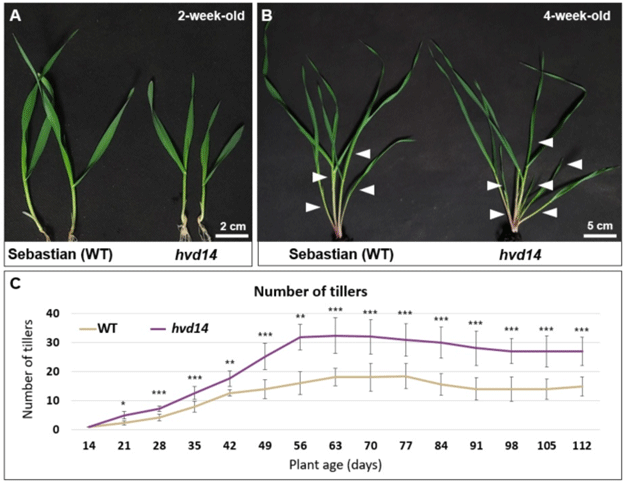
At the center of this process lies HvD14, the receptor protein for SL. In the hvd14 mutant, the receptor is non-functional, leading to insensitivity to SL signaling. The result? Plants show a semi-dwarf phenotype with significantly more tillers compared to wild-type plants — a phenotype that may initially appear desirable but is rooted in complex hormonal imbalances.
A Hormonal Domino Effect: AUX, CK, and ABA Dynamics
Comparative profiling of hormone levels between hvd14 and Sebastian revealed critical shifts:
- Auxin (AUX): Elevated transport and accumulation due to deregulated PIN1 expression and localization, known to be influenced by SL signaling.
- Cytokinin (CK): Increased CK levels, which are antagonistic to SL and AUX in shoot branching regulation, downregulating BRC1 — a key transcription factor that suppresses axillary bud outgrowth.
- Abscisic acid (ABA): ABA levels were also altered in the mutant, though its exact role in tillering regulation is less well-defined, it interacts with other hormones in stress and developmental signaling.
These hormonal changes correlate with transcriptomic and proteomic shifts, revealing differentially expressed genes (DEGs) and differentially abundant proteins (DAPs), many of which are transcription factors (TFs) potentially involved in SL signaling.
Gene Players in the Game: BRC1, SPL14, and More
The TEOSINTE BRANCHED1/CYCLOIDEA/PCF1 (TCP) family member BRC1 is a well-documented inhibitor of shoot branching, regulated both by SL and AUX. In Arabidopsis and rice, SL-depleted or SL-insensitive plants show lower BRC1 levels, while gain-of-function mutants in SL repressors reduce branching by elevating BRC1 expression.
In rice, SPL14 interacts directly with the SL pathway and suppresses OsTB1 (the BRC1 ortholog), acting as a molecular bridge between SL signaling and shoot suppression. These insights were extended to barley in the current study, where novel SL-related transcription factors were identified as candidates interacting with both AUX transport regulators and ABA signaling proteins.
Implications for Barley Breeding and Agronomy
Understanding how hormonal homeostasis shapes tillering allows breeders and agronomists to more precisely manipulate plant architecture. The hvd14 mutant, while displaying a higher number of tillers, might not always translate into higher yields due to potential source–sink imbalances, shading, and lodging risks.
Nonetheless, decoding the SL-insensitive phenotype provides a powerful tool for precision breeding, enabling:
- Selection of optimal tillering traits based on environment and target yield
- Exploration of hormone-responsive genes for gene editing
- Improved understanding of tiller fertility and grain number relationships
This study underscores the central role of strigolactone signaling in regulating shoot architecture through complex hormonal interactions involving AUX, CK, and ABA. The hvd14 barley mutant demonstrates that even a single mutation in the SL pathway can disrupt hormonal homeostasis, alter transcriptional networks, and redefine plant architecture. These findings lay the groundwork for hormone-informed breeding strategies aimed at optimizing barley yield and resilience.
Error