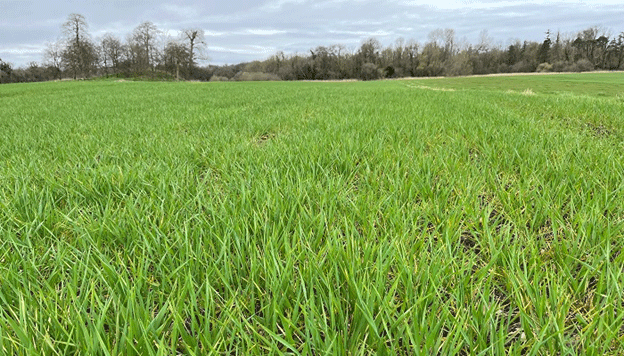
Thanks to favourable sowing conditions in autumn 2024, winter barley plantings in the UK and Ireland have increased significantly for the 2025 season. Crop establishment is reported as excellent, with minimal bare patches and strong early growth. But high yields don’t come from good starts alone — disease management will be the defining factor in turning potential into profit.
What Makes a High-Yielding Barley Crop?
Research shows that the key driver of yield in barley is the number of grains per square metre, with top-performing crops producing 18,000–20,000 grains/m². This is strongly influenced by ear number, which is set early in the season. Unlike wheat, barley lacks the compensatory ability to increase grain weight if ear numbers are low — making early-season disease control vital to preserve tiller development and maximize yield potential.
Disease Pressure: The 2025 Outlook
With an extended drilling window and large areas under barley, crops are at varying growth stages and exposed to differing disease risks. Net blotch, Rhynchosporium, and mildew are the most common threats from tillering through to stem extension, while Ramularia emerges as the dominant late-season issue.
Teagasc trials highlight that a three-spray fungicide programme delivers the most consistent results in winter barley:
- GS 25–30 (Late Tillering) – For early Rhynchosporium, Net Blotch, and Mildew
- GS 31–32 (Stem Extension) – Critical for protecting tiller development
- GS 45–49 (Awn Emergence) – Key timing for Ramularia control
Growers facing low disease pressure may consider a two-spray programme, focusing on stem extension and awn emergence, especially when working with more resistant varieties.
Matching Fungicide Chemistry to Disease Threats
Knowing when and what to spray is essential, and product selection should be guided by chemical group activity and disease spectrum:
| Growth Stage | Recommended Fungicide Strategy |
| GS 25–30 | Azole (Proline), SDHI (Imtrex), QoI (Comet) — for early disease suppression |
| GS 31–32 | Azole + SDHI or QoI + multisite (Folpet) — boosts tiller and ear retention |
| GS 45–49 | Azole + SDHI + QoI or Folpet — to delay Ramularia impact and protect yield |
Teagasc research shows Revystar XL, Macfare Xpro, and Prothioconazole/Folpet combinations offer effective Ramularia control, particularly when applied at GS 45–49. For mildew, Prothioconazole-based products are sufficient for most cases, though susceptible varieties like Cassia and Integral may benefit from adding a mildewicide.
Know Your Variety: Resistance Ratings for 2025
Understanding your variety’s disease resistance is essential to tailoring your programme. According to the Department of Agriculture’s 2025 recommended list, varieties like Belfry, SY Armadillo, and Orcade offer high resistance to Rhynchosporium, net blotch, and brown rust, reducing the need for early intensive spraying. On the other hand, KWS Cassia and Integral may require extra attention due to lower resistance scores.
| Variety | Mildew | Rhynchosporium | Brown Rust | Net Blotch |
| Belfry | 6 | 8 | 6 | 7 |
| Cassia | 5 | 4 | 7 | 7 |
| SY Armadillo | 6 | 8 | 5 | 7 |
| Integral | (5) | (6) | (7) | (7) |
Note: Ratings are out of 9; higher is better.
With a larger winter barley crop in the ground and strong establishment across most regions, the foundation for a successful 2025 harvest is in place. However, maintaining tiller numbers, controlling key diseases, and selecting the right fungicide programme at the right timing will determine whether this potential is realized. Teagasc’s ongoing research provides essential insights to help growers fine-tune their strategies, with a clear focus on early protection and resistance-based decision-making.
Error