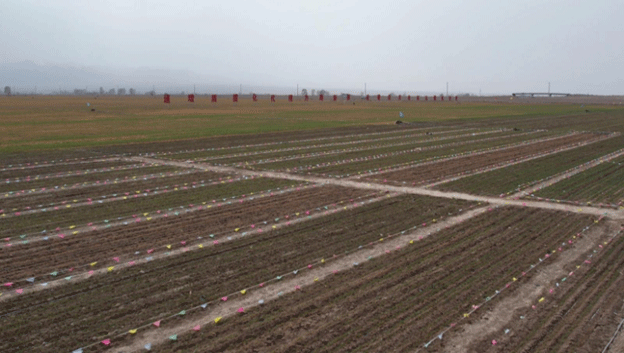
In Hutubi County, Xinjiang, fields are greening as 76,000 mu of winter wheat approach the crucial stem-elongation stage, a key phase in the development of tillers and grain-bearing spikes. To maximize yield and strengthen lodging resistance, local farmers and agricultural experts are turning to precision technologies and smart spring management—combining tradition with innovation.
At a large wheat field in Ningzhouhu Village, 20lidian Town, farmer Dong Feng watches as a plant protection drone buzzes above his 1,200 mu (≈80 hectares) of wheat. “We used to rely on manual spraying,” Dong says. “Now with drones, it’s faster, more accurate, and saves labor.”
Indeed, Hutubi County has deployed 46 drones across its wheat fields for real-time aerial pesticide and growth regulator applications. These drones, often guided by satellite systems such as Beidou, allow operators to:
- Monitor spray coverage via live-feed displays
- Adjust dosages based on crop health
- Reduce human exposure to agrochemicals
- Minimize plant damage due to trampling
The result is a 20–25x increase in spraying efficiency and a reduction of labor costs by 30–40 yuan per mu, as reported in other regions using similar tech. More importantly, drone-based chemical applications ensure uniform coverage and precise dose delivery, which is critical during the stem elongation period to regulate internode growth and prevent lodging.
At the same time, agronomic advisors are walking the fields, evaluating seedling vigor and soil moisture, and guiding farmers on timely nitrogen fertilization and pest prevention. Experts from the Hutubi County Agricultural Technology Promotion Center emphasize that this stage is decisive for determining ear size, spikelet number, and grain quality.
Hou Lihua, the Center’s Party Secretary, explains:
“From April 14–15, the wheat will begin stem elongation. We must act quickly—apply the second round of growth regulation, and for fields that haven’t yet received ‘head water’ (pre-irrigation), that must be done now. These steps will shorten lower stem internodes to prevent lodging and stimulate productive spike differentiation.”
Winter wheat is a cornerstone crop in Hutubi County’s food production system. Its consistent performance directly affects grain self-sufficiency in Xinjiang, where local authorities are pushing hard toward modern, mechanized, and science-based farming systems.
Recent trends across China support this approach. According to the Chinese Academy of Agricultural Sciences, integrating UAV-based crop protection, digital soil monitoring, and precision input management has been shown to raise wheat yields by 15–20% while lowering input costs. As more counties follow suit, these smart farming practices are expected to play a critical role in meeting the country’s 2025 food security and rural revitalization targets.
Hutubi County’s tech-powered approach to spring wheat management offers a clear example of how precision agriculture, even at the village level, can reshape yield potential and crop resilience. By acting at the right moment with the right tools—drones, expert knowledge, and well-timed agronomic interventions—farmers are not just protecting their harvest, but setting a new benchmark for efficient and scalable wheat production.
Error