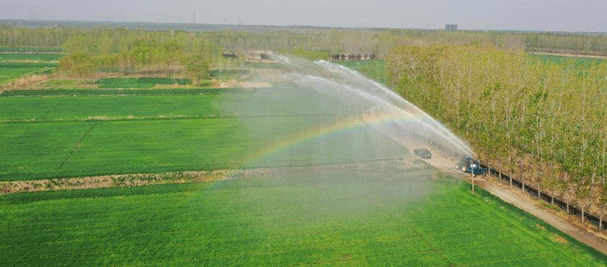
As drought continues to challenge crop production across parts of China, a transformation is taking place in Haizhou District, Jiangsu Province. At the Gangbu Farm, near Wanggou Production Zone, rows of wheat fields shimmer under the fine mist of smart irrigation machines, powered by cutting-edge sensors and navigation technology. These aren’t ordinary sprinklers—these are intelligent, sensor-equipped irrigation systems that are redefining drought resilience and grain productivity in real time.
In April 2025, Gangbu Farm launched 11 intelligent spraying machines across 64,000 mu (about 4,266 hectares) of wheat fields. Compared to traditional flood irrigation, these systems have improved efficiency by 300%. With rotating spray arms reaching 50 to 55 meters, guided by Beidou satellite navigation and radar distance-measuring technology, water is applied with surgical precision, targeting exactly 30 cm into the soil around wheat roots.
According to the farm’s senior operator, Xu Chuanqing, the machines automatically adjust water output based on real-time soil moisture data, collected by in-field sensors. This precision eliminates guesswork and minimizes water waste. The results are impressive:
- Water usage per mu reduced by over 60%
- Labor costs and time dramatically cut
- Yield increase of around 100 jin/mu (about 150 kg/ha)
These gains are achieved not just through machines, but through smart people adapting to smart tools. Veteran machinery operator Fang Xiaoxuan, with 20 years of experience, has transitioned into a digital-savvy technician, trained under the farm’s “theory + hands-on” model. As a result, equipment utilization now exceeds 98%, ensuring no device sits idle during critical drought periods.
Meanwhile, the agronomy control center oversees operations with a digital dashboard that displays soil conditions, wheat growth stages, and irrigation data for all 64,000 mu. Using drones and field cameras, agronomists assess plant health and pest activity, tailoring input plans for each plot. This “plot-specific strategy” optimizes fertilizer, pesticide, and water use while ensuring each wheat plant thrives.
And Haizhou isn’t stopping there.
The next phase includes:
- 3 IoT-based agricultural monitoring stations
- Integration of meteorological satellite data
- Development of drought prediction models
- Deployment of unmanned irrigation and drainage systems
These upgrades aim to push efficiency even further. The vision is clear: shift from “depending on the weather” to “acting according to the weather”, turning uncertainty into informed action.
This approach mirrors China’s broader strategy to safeguard national food security through smart farming. According to the Chinese Ministry of Agriculture and Rural Affairs, smart agriculture in China is expected to cover over 70 million hectares by 2030, using AI, IoT, and data analytics to transform how food is grown.
Haizhou District’s success in using smart irrigation to fight drought is a beacon for agricultural regions worldwide. By combining sensor-driven equipment, skilled personnel, and data-backed decision-making, the district has turned a climatic challenge into an opportunity for innovation. As global agriculture faces rising environmental stress, Haizhou’s model offers a compelling path toward resilient, resource-efficient, and high-yield farming.
Error