
New Discovery Boosts Wheat’s Fight Against Devastating Disease
A team of researchers led by Dr. Brande Wulff at KAUST has unveiled a previously unknown mechanism that wheat uses to initiate its immune response against Puccinia graminis f. sp. tritici, the fungal pathogen responsible for stem rust. Published in Science, the study offers not only fundamental insight into plant immunity but also potential game-changing applications in agricultural biotechnology.
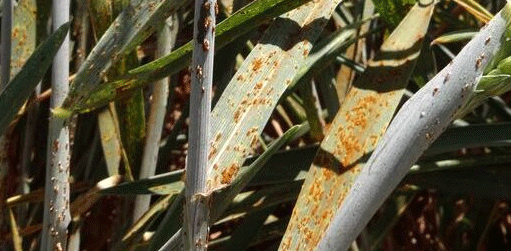
Stem rust, dubbed the “polio of wheat,” has historically led to catastrophic famines, wiping out entire harvests in multiple regions across the world. Although the deployment of resistant wheat varieties helped contain the disease in the latter half of the 20th century, recent climate change and the emergence of new rust strains — particularly the virulent Ug99 lineage — have renewed global concern. According to the Food and Agriculture Organization (FAO), stem rust and other fungal diseases cause global crop losses worth over $60 billion annually.
In their study, Wulff and colleagues from institutions across five continents discovered that a specific group of proteins called tandem kinases play a central role in wheat’s early immune signaling. These kinases, physically linked like handcuffed molecules, remain inactive until a pathogen, such as the stem rust fungus, binds to one of them. This interaction breaks the “handcuffs,” releasing the other kinase to trigger a cascade of defense responses, ultimately leading to programmed cell death. This mechanism starves the invading pathogen of nutrients, effectively halting its ability to spread.
This form of immunity, known as effector-triggered immunity (ETI), is not unique to wheat. The conserved nature of the tandem kinase response across cereal crops such as barley, maize, and rice suggests that this discovery could be broadly applied. In fact, gene editing tools like CRISPR/Cas9 and marker-assisted breeding are now being evaluated to introduce enhanced kinase configurations into commercial wheat lines, offering the potential for durable resistance.
Dr. Matthew Rouse, a rust expert from the USDA’s Cereal Disease Laboratory, called the discovery “a huge leap forward in understanding how wheat fights off one of its most ancient enemies.” He noted that the durability of current resistance genes has often been short-lived, with pathogens evolving rapidly to overcome them. “Now, we can design crops with resistance that’s not just effective, but smart — responsive to the first molecular handshake of infection,” he added.
In 2023, global wheat production reached 796 million metric tons, according to the International Grains Council, reaffirming its role as the world’s top traded food crop. Wheat is grown on more land than any other crop — about 220 million hectares globally — and serves as a dietary cornerstone for over 35% of the world’s population. As climate change intensifies disease pressures, innovations like this could mean the difference between resilience and collapse for global food systems.
This discovery marks a significant advancement in the field of plant immunity, offering a new molecular target for breeding disease-resistant wheat. As researchers continue to explore the role of tandem kinases in other cereal crops, the agricultural world moves closer to developing climate-resilient, disease-proof food systems that can withstand the growing challenges of the 21st century.