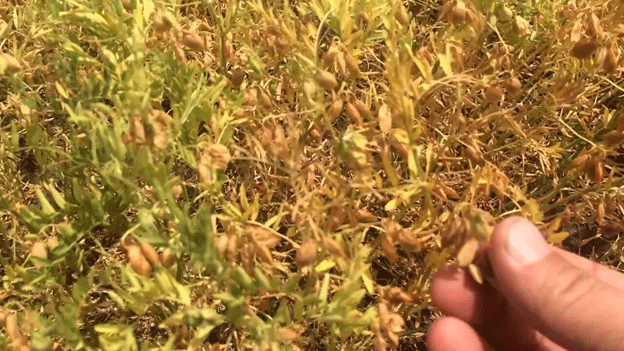
Turkey’s 2024 red lentil crop, initially threatened by severe drought conditions, is now showing signs of recovery after much-needed rainfall arrived in February. According to Tuba Memis, import/export manager at Memisoglu, rainfall came just in time to relieve stressed crops and support plant development, offering renewed hope to farmers and processors in the country’s pulse sector.
Turkey’s red lentils are primarily grown in the southeastern provinces, where planting typically takes place between November and January, with harvesting occurring in June. The early part of the season was marked by poor weather: December rainfall was 53% below average, and January remained very dry, placing significant stress on lentil fields.
Fortunately, February rains arrived just as crops were nearing critical growth stages. Both Memis and Mehmet Sonmez, a trader with Armada Foods, stated that weather conditions have since normalized. As a result, red lentil planting was up 10–15% compared to last year, and yields may also increase by a similar margin — potentially pushing production above 465,000 tonnes, up from 405,000 tonnes in 2023.
However, agronomists and growers remain cautious. Additional rainfall in April and May will be crucial to achieving a full recovery and maximizing yields.
A Key Player in Global Trade
Turkey occupies a unique role in the global lentil market. It acts as both a major importer and a re-exporter, creating a complex supply chain dynamic. During the first ten months of the 2023–24 marketing year, Turkey imported 364,000 tonnes and exported 408,000 tonnes of lentils, according to trade data. The discrepancy is due to re-exporting practices after processing.
Canada remains Turkey’s largest lentil supplier, accounting for roughly 50% of imports. Other key suppliers include Kazakhstan and Russia. On the export side, Iraq, Sudan, and Algeria were the top buyers, representing 58% of Turkey’s outbound trade.
Global Pulse Market Trends
The international lentil market is also shifting. India, the world’s largest lentil consumer, is forecasting a record production of 1.82 million tonnes this year, well above its five-year average of 1.44 million tonnes. In response, the Indian government recently introduced an 11% import duty, replacing a previous 0% duty — a move aimed at protecting domestic farmers but with manageable impacts on exporters, according to Pulse Canada President Greg Cherewyk.
Trade dynamics are further complicated by discussions around preferential import status for U.S. lentils, potentially offsetting retaliatory tariffs expected from the U.S. in April 2024.
Meanwhile, in Australia, another key exporter, lentil production has declined. The Australian Bureau of Agricultural and Resource Economics and Sciences (ABARES) projects 1.16 million tonnes for 2024, down from 1.57 million tonnes in 2023 — a 26% year-over-year drop, largely due to drier conditions.
Market Outlook: Demand, Prices, and Farmer Strategy
Despite a more favorable weather outlook in Turkey, traders like Sonmez caution that global demand remains subdued. High interest rates and abundant supply have led to weakened prices and hand-to-mouth purchasing behavior in several markets. These factors have contributed to an “absolute disappearance” in demand in early 2024–25.
Nonetheless, Turkey’s recovery in lentil production, if supported by favorable spring rains, may improve domestic availability and enhance its role as a regional processing and trade hub — especially for Middle Eastern and North African markets.
Turkey’s 2024 lentil crop recovery is a welcome sign for producers after months of drought stress. While global markets face shifting trade policies and softer demand, timely rainfall and increased planting area could allow Turkey to surpass last year’s production. As weather continues to play a defining role in crop outcomes, coordinated efforts in trade, crop management, and market responsiveness will be essential for farmers, exporters, and policymakers alike.
Error