• About
  • Advertise
  • Careers
  • Contact
Friday, December 5, 2025
  • Login
No Result
View All Result
Field Crops news
  • Home
  • News
  • AgroTech & Innovation
  • Science
  • Sustainability
  • Market News
  • Research & Development
  • Home
  • News
  • AgroTech & Innovation
  • Science
  • Sustainability
  • Market News
  • Research & Development
No Result
View All Result
Field Crops news
No Result
View All Result
Home Herbicides

Revolutionizing Weed Management in Cereal Crops: Edaptis®’ Dual-Action Solution

by Tatiana Ivanova
18 December 2024
in Herbicides, News
0
Revolutionizing Weed Management in Cereal Crops: Edaptis®’ Dual-Action Solution
0
SHARES
22
VIEWS
Share on FacebookShare on Twitter

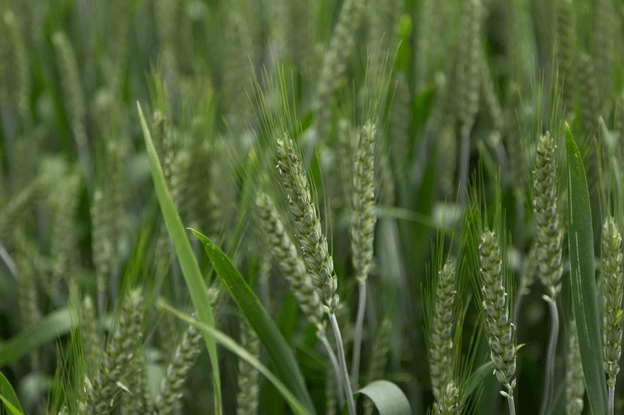
Effective weed management is critical for maximizing cereal yields and mitigating the risks of herbicide resistance. Grass weeds and broadleaf infestations, if left uncontrolled, can cause yield losses of up to 50%. To combat these challenges, Adama has introduced Edaptis®, a cutting-edge herbicide designed for post-emergence weed control in cereals like wheat and triticale.

What Makes Edaptis® Unique?

Edaptis® combines two active ingredients—mesosulfuron-methyl (12 g/L) and pinoxaden (60 g/L)—to deliver a dual mode of action that targets resistant and non-resistant grass weeds. This dual-action mechanism ensures a broader spectrum of control and reduces the likelihood of resistance development.

Key features include:

  • Broad-Spectrum Efficacy: Targets even the most difficult grass weeds.
  • Rapid Absorption: The innovative Adama-patented formulation allows for rainfastness within an hour of application.
  • Versatility: Can be mixed with major broadleaf herbicides and fungicides for integrated crop protection.
  • Ease of Application: Designed for use with 100–400 liters of water per hectare, ensuring uniform coverage of weeds.

Application Guidelines

  • Target Crops: Wheat and triticale.
  • Timing: Apply post-emergence, from the start of tillering to the flag leaf stage.
  • Rate: 1 liter/hectare, combined with Adama’s Parleaf, a rapeseed oil-based adjuvant for enhanced performance.
  • Compatibility: Mixable with broadleaf herbicides to control additional weed species.

Avoid applying Edaptis® to stressed crops, particularly those affected by abiotic factors like frost or drought, to prevent potential phytotoxicity.

Addressing Resistance

Herbicide resistance is a growing concern in cereal production. Over-reliance on single-action herbicides has led to the emergence of resistant weed populations, particularly in grass species. Edaptis®’ dual-action formula disrupts this trend by attacking weeds through complementary pathways.

The Bigger Picture

Global cereal production depends on sustainable weed management practices. Innovations like Edaptis® not only improve yield security but also promote responsible use of herbicides to preserve efficacy for future generations.


Edaptis® represents a significant step forward in post-emergence weed control for cereal crops. By combining advanced chemistry with practical application, it empowers farmers to tackle resistant weeds effectively while safeguarding long-term productivity.


Error
Tags: Adama Edaptis®Cereal Crop ManagementDual-Action HerbicidesGrass Weed SolutionsHerbicide ResistancePost-Emergence Herbicidessustainable agricultureweed control

Tatiana Ivanova

Next Post
Corn Markets in Transition: How Seasonal Pressures and Global Uncertainty Shape the Outlook

Corn Markets in Transition: How Seasonal Pressures and Global Uncertainty Shape the Outlook

Newsletter

Montane Oats: Pioneering Natural Farming for a Healthier Future

Montane Oats: Pioneering Natural Farming for a Healthier Future

4 August 2025

Fighting Viruses, Boosting Yields: How Ethiopia’s New Virology Lab is Reviving Lentil Production

24 March 2025

Tula Region Smashes Grain Harvest Record: A Benchmark for Central Russian Productivity

15 September 2025

Shutilovka Station Showcases 380 Crop Varieties: The Future of Russian Agriculture

4 July 2025

Tymen Region Completes Winter Crop Sowing for 2025: Key Insights and Implications for the Agricultural Sector

14 November 2024

African Development Bank Boosts Sudan’s Wheat Production with $100 Million Grant

28 October 2024

Early Harvest in Kalmykia Due to Heatwave and Drought Challenges

12 July 2024

U.S. Rice Production Declines in 2025-26: How India and Global Markets Could Benefit

20 June 2025

Kuban’s Rice Harvest Breaks Records: A Look at 2024’s Impressive Gains and Techniques

19 November 2024

Bashkortostan’s Grain Processing Boom: How Export Growth is Reshaping Regional Agriculture

2 August 2025
  • About
  • Advertise
  • Careers
  • Contact
Call us: +51 93 999 5140

© 2020-2024 Field Crops news

Welcome Back!

Login to your account below

Forgotten Password?

Retrieve your password

Please enter your username or email address to reset your password.

Log In
No Result
View All Result
  • Home
  • News
  • Science
  • Sustainability
  • AgroTech & Innovation
  • Market News
  • Science
  • Research & Development
  • About
  • Contact

© 2020-2024 Field Crops news