• About
  • Advertise
  • Careers
  • Contact
Friday, December 5, 2025
  • Login
No Result
View All Result
Field Crops news
  • Home
  • News
  • AgroTech & Innovation
  • Science
  • Sustainability
  • Market News
  • Research & Development
  • Home
  • News
  • AgroTech & Innovation
  • Science
  • Sustainability
  • Market News
  • Research & Development
No Result
View All Result
Field Crops news
No Result
View All Result
Home AgroTech & Innovation

Aiming High: Government Targets 3.3 Million Metric Tonnes of Cereal Production Amid Drought Challenges

by Tatiana Ivanova
17 December 2024
in AgroTech & Innovation, Climate, News
0
Aiming High: Government Targets 3.3 Million Metric Tonnes of Cereal Production Amid Drought Challenges
0
SHARES
15
VIEWS
Share on FacebookShare on Twitter

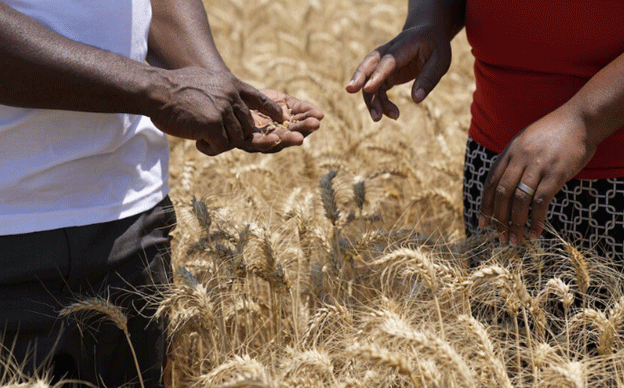
As climate challenges mount globally, governments are focusing on increasing food security and agricultural resilience. In Zimbabwe, the 2024/2025 Summer Season Plan sets an ambitious goal of producing 3.3 million metric tonnes (MT) of cereals, a dramatic 347% increase compared to the previous season’s 744,271 MT. Total crop production is targeted to exceed 4 million MT, a transformative leap for the nation.

Challenges: An El Niño-Induced Dry Spell

The 2023/2024 agricultural season was marred by an El Niño-induced drought, a phenomenon known to cause irregular rainfall and reduce crop yields worldwide. As a result:

  • Zimbabwe’s cereal production dropped to 744,271 MT.
  • The Strategic Grain Reserve stocks were limited to 245,052 MT of wheat, maize, and traditional grains.

This year’s improved seasonal forecast of normal to above-normal rainfall presents a critical opportunity for recovery.

Government Measures to Meet Targets

The government has introduced robust strategies to overcome the drought’s impacts and boost production:

  1. Presidential Input Schemes:
  1. Over 746,238 hectares of maize have been planted under government support programs, reaching 41.5% of the target.
  2. Nearly 117% of the targeted 9 million plots have been prepared by 116% of the 3 million rural households.
  3. Enhanced Farmer Support Programs:
  1. Distribution of drought-resistant seeds and inputs to smallholder farmers.
  2. Expansion of irrigation infrastructure to mitigate rainfall variability.
  3. AGRITEX Advisories:
  4. Farmers are urged to rely on localized agronomic advisories to maximize yields under unpredictable weather conditions.

Broader Context: Regional and Global Comparisons

Zimbabwe’s cereal production target aligns with global calls for food system transformation in response to climate change. For instance:

  • In Africa, droughts have caused cereal production declines of up to 30% in severely affected areas, according to FAO data.
  • Countries like Ethiopia and Kenya are also heavily investing in drought mitigation and irrigation expansion to boost production.

Sustainability Through Diversification

While cereals dominate the plan, the government has also emphasized increasing pulses production to 819,500 MT, reinforcing the importance of crop diversification for nutrition and resilience.

Zimbabwe’s 2024/2025 agricultural targets reflect the country’s commitment to addressing food security challenges head-on. By leveraging improved rainfall forecasts, farmer support programs, and agronomic expertise, the government seeks to build a resilient agricultural sector capable of weathering climate variability. Achieving this ambitious goal will require coordinated efforts among policymakers, farmers, and scientists, but the stakes—ensuring national food security—could not be higher.


Error
Tags: Agriculture in ZimbabweAGRITEXCereal Productioncrop yieldsDrought MitigationEl Niñofood securityStrategic Grain Reservesustainable farming practices

Tatiana Ivanova

Next Post
Global Cereal Production Set to Reach 2.859 Billion Tonnes in 2024-2025: Opportunities and Challenges for Agriculture

Global Cereal Production Set to Reach 2.859 Billion Tonnes in 2024-2025: Opportunities and Challenges for Agriculture

Newsletter

Endophytic entomopathogenic fungi as biological control agents of insect pests

Endophytic entomopathogenic fungi as biological control agents of insect pests

5 August 2024

Breakthrough in Oat Cultivation: HAU’s New High-Yield Varieties Promise Better Forage and Higher Profits

5 August 2025

Integrated disease management of powdery mildew in cereals

1 July 2024

Corn Yield Decline in Russia: Impacts on Exports and Domestic Demand

20 September 2024

Wheat Fields in Edirne Under Inspection: Impact of Recent Rain and Early Sowing Issues

6 January 2025

Volgodonsk’s Grain Elevator Up for Sale: What This Means for Russia’s Agricultural Export Infrastructure

12 August 2025

Soybean Harvest Begins in the U.S.: A Look at Early Progress and Crop Conditions

20 September 2024

Mastering Pea Farming: Scientific Techniques for Higher Yields and Profits

24 October 2024

Boosting Crop Quality and Yield: Latest Insights from Seed Certification in Stavropol Krai

2 July 2025

Russia’s Wheat Exports to China Surge: What This Means for Global Grain Markets

11 November 2024
  • About
  • Advertise
  • Careers
  • Contact
Call us: +51 93 999 5140

© 2020-2024 Field Crops news

Welcome Back!

Login to your account below

Forgotten Password?

Retrieve your password

Please enter your username or email address to reset your password.

Log In
No Result
View All Result
  • Home
  • News
  • Science
  • Sustainability
  • AgroTech & Innovation
  • Market News
  • Science
  • Research & Development
  • About
  • Contact

© 2020-2024 Field Crops news