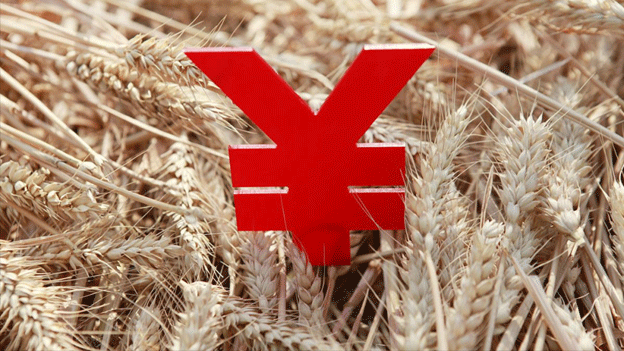
As of early November, China’s wheat market reflects a struggle between supply and demand forces, with a mixed sentiment pervading across the industry. The current situation has left traders, processors, and farmers grappling with a market that shows signs of stability but lacks strong upward momentum.
Weak Demand for Wheat Products
Despite the arrival of colder weather and the beginning of the traditional wheat consumption season, demand for wheat-derived products remains sluggish. Flour mills, which usually increase production around this time to meet rising consumer needs, are facing multiple economic challenges. Low corn prices have pressured bran sales, a key byproduct of flour production. Currently, bran prices are hovering around ¥1,700 per ton, reducing profit margins for milling companies. Consequently, flour mills are operating at lower-than-average capacities, relying more on existing stockpiles and cautiously approaching new wheat purchases. Additionally, downstream traders remain hesitant to stock up, keeping the wheat market under supply strain.
An Abundant Supply Keeps Prices in Check
Several factors contribute to a more relaxed supply environment for wheat in China. First, there has been a significant volume of imported wheat. As of late September, cumulative wheat imports for the year reached 10.74 million tons. Although imports have slowed in the fourth quarter, the impact of foreign wheat on the domestic market persists. Second, both local grain traders and farmers are increasingly eager to sell off their wheat stocks, driven by concerns over weakening price trends and limited market shortages. This has led to more wheat being released into the market.
Another critical factor influencing wheat supply is government policy. The state grain reserve agency, Sinograin, has been auctioning off older wheat stocks to regulate the market. On November 8, for example, 84,782 tons of wheat were auctioned, with a transaction rate of 78% and prices between ¥1.20 and ¥1.25 per jin (roughly ¥1,200–1,250 per ton). These auctions align closely with current market prices, adding to the pressure on domestic wheat supply and pricing stability.
Regional Wheat Prices: A Stable Yet Fragile Picture
As of November 9, average wheat prices across China’s key wheat-producing regions have remained relatively steady. Here’s a breakdown of the regional data:
- Hebei Province: Average prices among flour processing companies stand at ¥1.221 per jin. Variations are minor, with specific adjustments like Baixiang Wudeli lowering its price by 0.4 cents to ¥1.226 per jin and Daming Wudeli increasing by 0.2 cents to ¥1.227 per jin.
- Shandong Province: The average wheat price is ¥1.233 per jin, with most quotes holding firm between ¥1.213 and ¥1.252 per jin. A few minor adjustments, like Heze Huarui’s decrease of 0.2 cents to ¥1.24 per jin, have been reported.
- Henan Province: Prices are also stable at an average of ¥1.235 per jin, with key market players quoting between ¥1.226 and ¥1.247 per jin.
- Jiangsu, Anhui, and Shaanxi Provinces: The regional average is ¥1.236 per jin, with the main range from ¥1.226 to ¥1.252 per jin. Specific increases, such as Xinghua Wudeli’s rise of 0.5 cents to ¥1.243 per jin, highlight pockets of price variability.
Across 80 monitored enterprises nationwide, only two increased prices, three decreased, and the remaining 75 kept their rates unchanged. This reflects a market situation where pricing is largely stable but lacks significant upward force.