In an era marked by geopolitical tensions and environmental challenges, the importance of food security has never been more critical. Recent advances in agricultural research have positioned Russia on a path to self-sufficiency in rice production, as highlighted by Nikolai Kuzmich Dolgushkin, Vice President of the Russian Academy of Sciences (RAS). At the forum “Scientific Support for Food Security Amid Global Challenges,” Dolgushkin emphasized the crucial role of domestic research in addressing the country’s agricultural needs.
Achieving Rice Self-Sufficiency
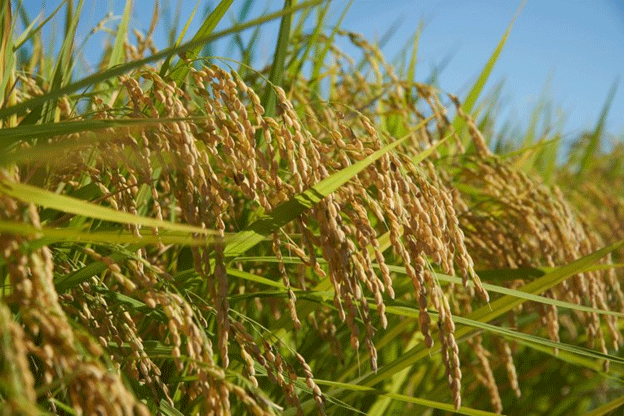
Thanks to the efforts of the Federal Scientific Center for Rice, Russia now relies on its own seeds for approximately 90-95% of its rice production. This accomplishment reflects a broader trend in Russian agriculture aimed at achieving technological sovereignty and reducing dependence on foreign imports. The center has registered 37 rice varieties, dominating the market in the Krasnodar region, where its seeds accounted for an impressive 99.6% of plantings in 2021. Nationally, these varieties contributed to 85.4% of total rice production.
The need for self-sufficiency is underscored by the significant risks posed by external factors, including climate change, economic instability, and demographic shifts. Dolgushkin noted that these challenges require innovative approaches from the scientific community to bolster production capabilities and mitigate risks associated with agricultural dependencies.
The Broader Agricultural Landscape
The implications of achieving rice self-sufficiency extend beyond just rice production. Dolgushkin pointed out that technological lag remains one of the most pressing challenges for Russia’s agricultural sector. The increasing reliance on advanced technology is paramount, as traditional practices alone may not meet the demands of modern agriculture.
Organizations like the National Center for Lukyanenko and the Federal Research Center “Nemchinovka” have made remarkable strides in wheat breeding, yielding varieties with productivity exceeding 120 quintals per hectare. The success of these institutions exemplifies the potential of scientific collaboration to overcome agricultural challenges.
Moreover, recent data shows that Russia’s rice export has matched its import levels, reaching approximately 193,000 tons for exports and 188,000 tons for imports, highlighting the country’s ability to compete on the global stage.
The progress made by Russian scientists in achieving rice self-sufficiency is a beacon of hope for the agricultural sector amid ongoing global challenges. By investing in domestic research and innovation, Russia is taking significant steps toward securing its food production and addressing the risks posed by external dependencies. As agricultural practices become increasingly high-tech, the collaboration between scientists, agronomists, and farmers will be essential in cultivating a sustainable agricultural future.
Error