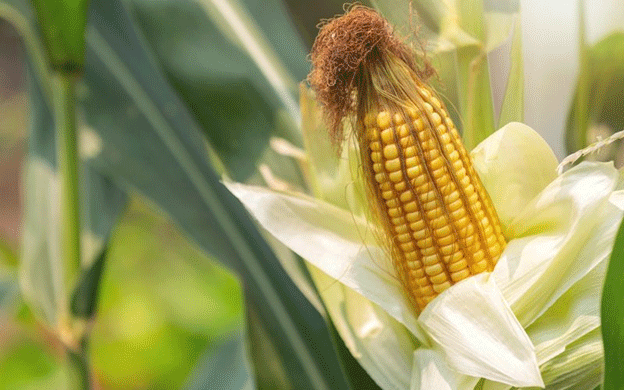
Russia is poised to significantly expand its corn exports, with projections indicating that overseas shipments could surpass 8.7 million tons annually by 2030. These figures, provided by the federal center “Agroexport,” highlight the growing role of Russian corn in international markets. This projection reflects a strong upward trend in Russia’s agricultural export strategy, which seeks to capitalize on increased global demand for grains.
Between January and August 2024, Russia exported over 5 million tons of corn, marking a 7% increase compared to the same period last year. This steady rise in export volume points to a resilient supply chain and favorable market conditions, despite fluctuations in global grain production and pricing.
The top importers of Russian corn are dominated by countries in the Middle East and North Africa (MENA) region. Iran leads as the largest buyer, accounting for 47% of Russian corn exports, followed by Turkey at 31% and Libya at 4%. This regional demand showcases Russia’s strategic export focus and the importance of stable trade relationships in these key markets.
Several factors contribute to Russia’s growing corn export capacity. First, investments in agricultural infrastructure and technology have boosted production efficiency. These advancements enable Russian farmers to scale up corn cultivation while maintaining cost-effectiveness, positioning the country as a competitive player in global markets. Second, favorable climate conditions in certain regions of Russia, combined with the adoption of modern farming techniques, have led to more consistent and higher-quality yields.
The Russian government’s efforts to diversify agricultural exports have also played a crucial role. Expanding export markets beyond Europe and into the MENA region has proven to be a successful strategy, given the growing demand for corn in these areas. Additionally, geopolitical shifts have encouraged Russia to strengthen trade ties with non-Western markets, further driving the expansion of its agricultural exports.
Looking ahead, the forecast of 8.7 million tons by 2030 reflects optimism about both Russia’s production capacity and the increasing appetite for corn in global markets. As demand rises, especially in regions like the Middle East, Russia is well-positioned to become a more dominant player in the corn trade.
However, achieving this ambitious goal will require overcoming challenges such as fluctuating global prices, potential trade restrictions, and maintaining high yields in the face of changing climate conditions. Yet, with strong government support, investments in agricultural technology, and solid trade partnerships, Russia’s corn export industry seems set for sustained growth.
Russia’s corn exports are on track to exceed 8.7 million tons by 2030, supported by increased global demand and strategic expansion into key markets like Iran and Turkey. With a 7% rise in exports in 2024 alone, the country’s investment in agriculture and its focus on strengthening international trade relationships are paying off. As the world’s appetite for corn grows, Russia is set to play a leading role in meeting that demand.
Error