• About
  • Advertise
  • Careers
  • Contact
Friday, December 5, 2025
  • Login
No Result
View All Result
Field Crops news
  • Home
  • News
  • AgroTech & Innovation
  • Science
  • Sustainability
  • Market News
  • Research & Development
  • Home
  • News
  • AgroTech & Innovation
  • Science
  • Sustainability
  • Market News
  • Research & Development
No Result
View All Result
Field Crops news
No Result
View All Result
Home News

Rebuilding After the Flood: Why Coarse Grains Are the Best Choice for Affected Farmers

by Tatiana Ivanova
2 August 2024
in News
0
Rebuilding After the Flood: Why Coarse Grains Are the Best Choice for Affected Farmers
0
SHARES
1
VIEWS
Share on FacebookShare on Twitter

Recent heavy rains and flooding have severely damaged rice crops in Shahjahanpur, leaving fields empty and farmers in need of immediate solutions. With traditional crops lost, many farmers are preparing to replant, but the question is: what should they plant to recover quickly and efficiently?

Government Support and Coarse Grains

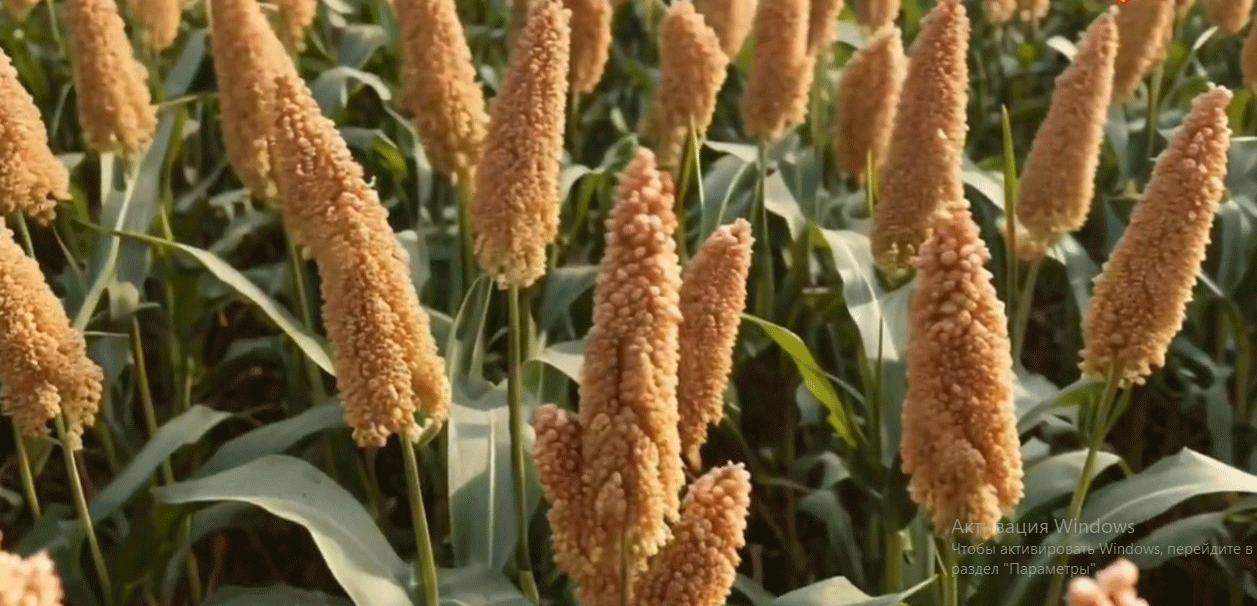
In response to the crisis, the government is distributing free mini seed kits for five types of coarse grains: jowar, bajra (pearl millet), ragi (finger millet), sama (barnyard millet), and kodo (kodo millet). According to Dr. Dheerendra Singh, Deputy Director of Agriculture, approximately 133 villages in Shahjahanpur district have been affected by the floods. These seed kits are designed to support farmers in transitioning to these resilient crops.

Coarse grains offer several advantages over traditional rice cultivation:

  1. Low Cost and Minimal Input: Coarse grains require significantly less water and fertilizers compared to rice. This makes them ideal for areas affected by floods where resources are scarce.
  2. Quick Growth: These crops have shorter growing periods, allowing for faster recovery and income generation.
  3. Higher Resilience: Coarse grains are more resilient to environmental stress and can thrive in less-than-ideal conditions.

Expert Recommendations

Agricultural experts recommend coarse grains for their low production costs and high profitability potential. By utilizing these seed kits, farmers can minimize their expenses and achieve a quicker turnaround, helping to mitigate the financial impact of the recent floods.

With the devastation caused by floods, transitioning to coarse grains offers a practical and beneficial solution for farmers. The government’s initiative to provide free seed kits is a timely support that can help farmers recover economically and continue their agricultural activities with reduced risks. By focusing on these resilient crops, farmers can rebuild their livelihoods while contributing to sustainable agricultural practices.

Error

Tags: agricultural supportCoarse GrainsCrop ResilienceFarm RecoveryFlood RecoveryFree Seed KitsMillet FarmingShahjahanpur Floodssustainable agriculture

Tatiana Ivanova

Next Post
Reviving Buckwheat: How a Traditional Crop is Making a Comeback in Quebec

Reviving Buckwheat: How a Traditional Crop is Making a Comeback in Quebec

Newsletter

Boosting Azerbaijan’s Agriculture: Russian-Bred Wheat and Soybean Seeds Offer High-Yield Potential

Boosting Azerbaijan’s Agriculture: Russian-Bred Wheat and Soybean Seeds Offer High-Yield Potential

18 May 2025

The Quality Premium: How a Deficit of High-Grade Wheat is Reshaping Kazakhstan’s Grain Market

19 October 2025

Nutrien Commits $1M to Support Sustainable Rice Farming

2 July 2024

The Rye Crisis: Soaring Prices, Shrinking Harvests, and the Fight for a Traditional Crop

16 September 2025

Feedgrain Values in South-Eastern Australia Bolstered by Grazier Demand

1 July 2024

USDA Releases Stocks and Acreage Report: Insights and Market Reactions

3 July 2024

Snowbound Harvest: Crisis or Manageable Delay for Kazakhstan’s Wheat?

16 October 2025

Jiangxi Green Top Biological Technology Co., Ltd.: A Leader in Humic Acid Fertilizers

25 September 2024

CABI assists the Philippines in assessing the impact of fall armyworm in rice

19 August 2024

Early Snowfall in Kazakhstan: A Harbinger of Quality Loss and Harvest Peril

2 October 2025
  • About
  • Advertise
  • Careers
  • Contact
Call us: +51 93 999 5140

© 2020-2024 Field Crops news

Welcome Back!

Login to your account below

Forgotten Password?

Retrieve your password

Please enter your username or email address to reset your password.

Log In
No Result
View All Result
  • Home
  • News
  • Science
  • Sustainability
  • AgroTech & Innovation
  • Market News
  • Science
  • Research & Development
  • About
  • Contact

© 2020-2024 Field Crops news