
• About
  • Advertise
  • Careers
  • Contact
Saturday, December 13, 2025
  • Login
No Result
View All Result
Field Crops news
  • Home
  • News
  • AgroTech & Innovation
  • Science
  • Sustainability
  • Market News
  • Research & Development
  • Home
  • News
  • AgroTech & Innovation
  • Science
  • Sustainability
  • Market News
  • Research & Development
No Result
View All Result
Field Crops news
No Result
View All Result
Home News

Identifying Common Wheat Defects: Fusarium Head Blight, Mildew, and Imperfect Grains

by Kira Demina
24 July 2024
in News
0
Identifying Common Wheat Defects: Fusarium Head Blight, Mildew, and Imperfect Grains
0
SHARES
15
VIEWS
Share on FacebookShare on Twitter

A Comprehensive Guide to Recognizing and Assessing Wheat Quality for Feed Production

Fusarium Head Blight

1. Fusarium Head Blight: Gray Grain

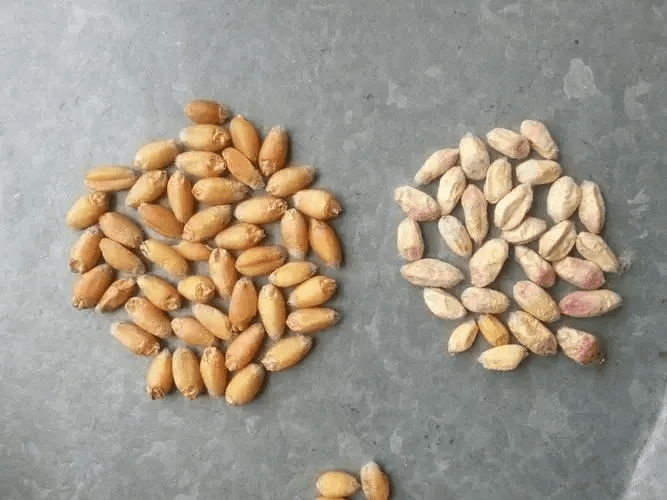
Gray grains are characterized by their shriveled, shrunken appearance, and dull white color. These grains are loose, brittle, and less silty with a gray tint. They exhibit a light specific gravity and can often be separated by wind sieve and water drift. This condition results from bacterial infection during the flowering stage under high temperature and humidity. The infection leads to the growth of gray hyphae without spores, causing the grain to turn gray and white.

2. Fusarium Head Blight: Red Grain

Red grains, also known as mycored granules, display a pink, rose red, or orange red hue originating from the embryo and spreading to other parts of the grain. These grains are deflated and thin, with varying degrees of cortex shriveling and loose, opaque organization. This coloration occurs due to bacterial infection during the flowering stage, where favorable temperature and humidity conditions lead to extensive conidia multiplication and pigment secretion.

3. Fusarium Head Blight: Gray-Green Grain

Gray-green grains exhibit a dark bluish-gray color on the cortex, with a matte powdery appearance. The grain is shriveled, loose, and qualitatively changed. This defect arises when pathogens infect wheat during the milk stage, absorbing nutrients and altering the grain’s characteristics.


Mildew in Wheat

4. Mildew Grain

Mildewed grains are biprismatic, awn-like, and account for about half the size of normal wheat grains. They are lightweight, smaller, and often resemble wheat skins. These grains are black, break easily under pressure, and emit a distinct odor. Mildew infection leads to a notable decrease in grain quality and nutritional value.


Imperfect Grains

5. Imperfect Wheat Grain

Imperfect grains are identified by their visual defects when inspected over a 10 cm² area. Typically, about 2.5% of the grains in a sample are found to be incomplete or flawed. Common imperfections include concave, wrinkled, or deeply sulcus grains, accounting for approximately 1.4% of the total. These defects include insect erosion, breakage, mildew, diseased spots, and sprouted grains, which significantly affect the grain’s quality and suitability for feed.

Error

Tags: feed qualityFusarium head blightGrain Qualityimperfect grainsmildew wheatwheat assessmentwheat defects

Kira Demina

Next Post
Wheat Protein Market Trends: Growth Forecast and Key Insights for 2024-2030

Wheat Protein Market Trends: Growth Forecast and Key Insights for 2024-2030

Newsletter

China Grain Reserves Corporation to Expand Wheat Procurement in 2024: Implications for Farmers and the Agricultural Sector

China Grain Reserves Corporation to Expand Wheat Procurement in 2024: Implications for Farmers and the Agricultural Sector

5 August 2024

Understanding the Decline in Russian Grain Exports: Implications for Global Agriculture

27 September 2024

French Concerns Rise Amid Strengthening Algerian-Italian Agricultural Alliance

20 February 2025

Spring Sowing in Altai Krai: Progress, Challenges, and Key Insights for 2024

4 July 2025

Harvest 2024 in Focus: EAO’s Grain Campaign Reveals Key Yield Trends and Regional Strategies

9 September 2025

Introducing the Latest Soybean Varieties: Advancing Machine Harvesting and High-Quality Tofu Production

2 December 2024

Iran Faces Sharp Decline in Wheat Yields: Weather Woes May Force Surge in Imports

25 April 2025

The Vital Role of Soil Testing in Enhancing Crop Nutrition

15 October 2024

SovEcon Raises 2025 Russian Wheat Forecast: Strong Winter Wheat Offsets Spring Challenges

24 April 2025

Feedgrain Values in South-Eastern Australia Bolstered by Grazier Demand

1 July 2024
  • About
  • Advertise
  • Careers
  • Contact
Call us: +51 93 999 5140

© 2020-2024 Field Crops news

Welcome Back!

Login to your account below

Forgotten Password?

Retrieve your password

Please enter your username or email address to reset your password.

Log In
No Result
View All Result
  • Home
  • News
  • Science
  • Sustainability
  • AgroTech & Innovation
  • Market News
  • Science
  • Research & Development
  • About
  • Contact

© 2020-2024 Field Crops news