• About
  • Advertise
  • Careers
  • Contact
Thursday, January 29, 2026
  • Login
No Result
View All Result
Field Crops news
  • Home
  • News
  • AgroTech & Innovation
  • Science
  • Sustainability
  • Market News
  • Research & Development
  • Home
  • News
  • AgroTech & Innovation
  • Science
  • Sustainability
  • Market News
  • Research & Development
No Result
View All Result
Field Crops news
No Result
View All Result
Home Science

Dhurrin content and biomass yield in sorghum hybrids throughout plant growth cycle

by Maria YEROKHOVA
16 July 2024
in Science
0
Dhurrin content and biomass yield in sorghum hybrids throughout plant growth cycle
0
SHARES
10
VIEWS
Share on FacebookShare on Twitter

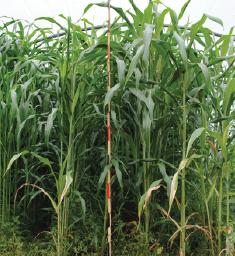
In recent years, the use of sorghum (Sorghum bicolor) in crop rotation as a green manure to decrease nematode infestation and promote the growth of subsequent crops has strongly increased. The reason why sorghum is effective in biofumigation against root-knot nematodes is because it releases dhurrin, a cyanogenic glycoside found in epidermal leaf tissue. Currently, there is little information regarding dhurrin production deriving from dhurrin concentration and biomass produced. A field study was conducted in northeastern Italy to investigate the change in dhurrin content and biomass production of three commercial sorghum-sudangrass cultivars (Hay Day, Mataco, and Ruzrok), over their entire growth cycle under seeding dates (May and July). Regardless of the growing period, Ruzrok displayed a higher dhurrin production. During the early growth stages, Ruzrok did not exhibit a higher yield compared with Mataco and Hay Day, hence its higher potential as a biofumigant is due to the higher concentration of dhurrin in plant tissues. During spring conditions, all tested cultivars showed higher dhurrin production up to a height of 100 cm, while the amount of dhurrin did not significantly change during the entire growing period in summer.

Reference: Macolino, S., Pornaro, C., Pignata, G., & Lauriault, L. (2024). Dhurrin content and biomass yield in sorghum hybrids throughout plant growth cycle. Agrosystems, Geosciences & Environment, 7, e20472. https://doi.org/10.1002/agg2.20472

Error

Tags: biofumigationSoil HealthSorghum bicolor

Maria YEROKHOVA

Next Post
Turkey Emerges as Leading Buyer of Russian Grain Despite a 30% Drop in Purchases

Turkey Emerges as Leading Buyer of Russian Grain Despite a 30% Drop in Purchases

Newsletter

New Harvest Plan 24/25: More Resources and 63% More Efficient

New Harvest Plan 24/25: More Resources and 63% More Efficient

8 July 2024

AMBA’s 2025 Malting Barley Variety List: New Additions and Industry Shifts

19 January 2025

Tambov Region Harvests 3.7 Million Tons of Grain: Soybeans Show Remarkable Growth Despite Challenges

30 October 2024

The Moroccan Milling Scandal: A Crisis of Oversight and a Sector in Need of Structural Reform

14 December 2025

Kazakhstan’s Winter Wheat Outlook: Average Yields Predicted Amid Regional Variability

26 June 2025

Illinois Farmers Face Uncertainty as U.S.-Mexico Trade Tensions Escalate​

6 March 2025

Harvesting Corn: Identifying the Right Time for Maximum Profit

26 September 2024

Wheat Producers Face Profitability Crisis as Prices Plummet

15 July 2024

The Expanding United States Cultured Wheat Market: Trends and Opportunities

24 July 2024

The Surge in Ukrainian Wheat Imports: Implications for Vietnam’s Agricultural Sector

3 August 2024
  • About
  • Advertise
  • Careers
  • Contact
Call us: +51 93 999 5140

© 2020-2024 Field Crops news

Welcome Back!

Login to your account below

Forgotten Password?

Retrieve your password

Please enter your username or email address to reset your password.

Log In
No Result
View All Result
  • Home
  • News
  • Science
  • Sustainability
  • AgroTech & Innovation
  • Market News
  • Science
  • Research & Development
  • About
  • Contact

© 2020-2024 Field Crops news