• About
  • Advertise
  • Careers
  • Contact
Thursday, December 4, 2025
  • Login
No Result
View All Result
Field Crops news
  • Home
  • News
  • AgroTech & Innovation
  • Science
  • Sustainability
  • Market News
  • Research & Development
  • Home
  • News
  • AgroTech & Innovation
  • Science
  • Sustainability
  • Market News
  • Research & Development
No Result
View All Result
Field Crops news
No Result
View All Result
Home Science

Sunflower broomrape: a life cycle and broomrape infestation in sunflower (part I)

by Maria YEROKHOVA
2 July 2024
in Science, Sustainability
0
Sunflower broomrape: a life cycle and broomrape infestation in sunflower (part I)
0
SHARES
8
VIEWS
Share on FacebookShare on Twitter

Broomrape species (Orobanche and Phelipanche spp., Orobanchaceae) are root parasitic weeds which are particularly harmful to crops, including tobacco, tomato, and sunflower. These weeds drastically reduced the quality and production of crops. Broomrape (Orobanche cumana) is a significant obstruction to sunflower cultivation, mainly in the Middle East, Southeast Europe, and Asia.

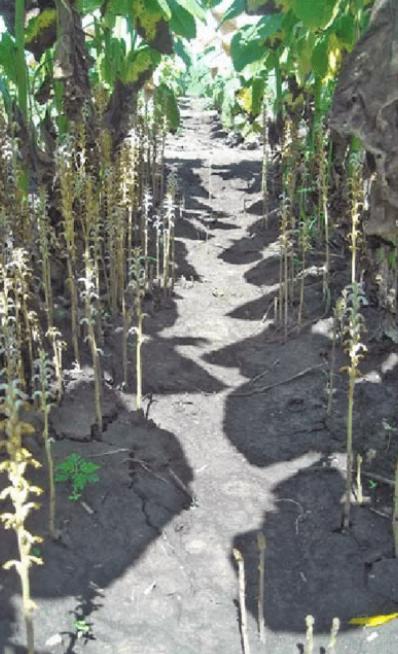
The invasion of O. cumana has the potential to reduce the sunflower yield by up to 80 %. The life cycle of O. cumana consists of four stages. In the soil, O. cumana seeds remain in an inactive state until activated by germination cues produced by host plant roots (stage 1). Right after germination, O. cumana initiates contact with host plant roots through haustoria, and root exudates enhance its development. O. cumana releases a number of enzymes (protease, cellulase, and xylanase, etc.) involved in cell wall degradation and establishes a haustorial attachment to ease its penetration into the host roots (stage 2). Upon reaching the vascular bundles of the host plant roots, O. cumana (via haustoria) draws water, essential nutrients and other macromolecules, resulting in host weakening. During Stage 3, a nutrient storage site (tubercle) rapidly develops at the attachment point, a place of underground shoot emergence. The 4th and last stage begins with the above-ground emergence of O. cumana, characterized by the development of flowering spikes and the production of seeds. The basic infestation mechanism is that O. cumana interferes with plant metabolism, restricts the uptake of essential mineral nutrients, impairs the photosynthetic performance, causes extra generation of reactive oxygen species, lipids peroxidation, imposes the ultrastructural cellular damages and synchronizes the antioxidants defence system.

Error

Tags: broomrapesunflower

Maria YEROKHOVA

Next Post
India Imposes Wheat Stock Limits to Ensure Food Security and Curb Hoarding

India Imposes Wheat Stock Limits to Ensure Food Security and Curb Hoarding

Newsletter

Breaking New Ground: Russian Wheat Sets Sail for Nigeria

Breaking New Ground: Russian Wheat Sets Sail for Nigeria

28 September 2024

The Expanding United States Cultured Wheat Market: Trends and Opportunities

24 July 2024

Green Corridor Initiative: Kazakhstan’s Strategic Move to Boost Grain Exports to China

8 December 2024

Myanmar’s Pulse Export Success Amid Price Fluctuations: Black Gram and Mung Bean Prices Decline

3 December 2024

Global Grain Market Update: Wheat Prices Firm While Canola Declines

6 September 2024

Brazilian Coffee Farming Embraces Sustainability with New Carbon Credit Initiative

19 July 2024

South Australia’s Grain Production Forecast for 2024-25 Season

10 August 2024

Decrease in Wheat Yield in Konya: A Detailed Analysis

11 July 2024

Kazakhstan Shatters Grain Export Records: New Markets and Strategic Growth

15 August 2025

BRICS Countries Back Russia’s Initiative to Establish Grain Exchange

18 July 2024
  • About
  • Advertise
  • Careers
  • Contact
Call us: +51 93 999 5140

© 2020-2024 Field Crops news

Welcome Back!

Login to your account below

Forgotten Password?

Retrieve your password

Please enter your username or email address to reset your password.

Log In
No Result
View All Result
  • Home
  • News
  • Science
  • Sustainability
  • AgroTech & Innovation
  • Market News
  • Science
  • Research & Development
  • About
  • Contact

© 2020-2024 Field Crops news