In a landmark achievement for Siberian agriculture, the Ishimsky Agrokholding has reported a record-breaking grain yield of 80 centners per hectare (approximately 8 tonnes/ha) for the 2025 season. This result is particularly significant as it was attained in a zone traditionally classified as risky farmland, demonstrating the profound impact of modern agronomic practices and technology in overcoming environmental constraints.
The holding’s success is attributed to a systematic, technology-driven approach built on several key pillars:
- Precision Agriculture: The implementation of precision farming techniques allowed for the optimized use of inputs like seeds, fertilizers, and pesticides, maximizing efficiency and minimizing waste.
- Adapted Varieties: The use of modern grain varieties specifically bred for local climatic conditions was crucial, enhancing crop resilience to weather stress and disease.
- Advanced Agrotechnology: The integration of state-of-the-art methods in fertilization and plant protection, supported by continuous field monitoring, ensured optimal crop health throughout the growing season.
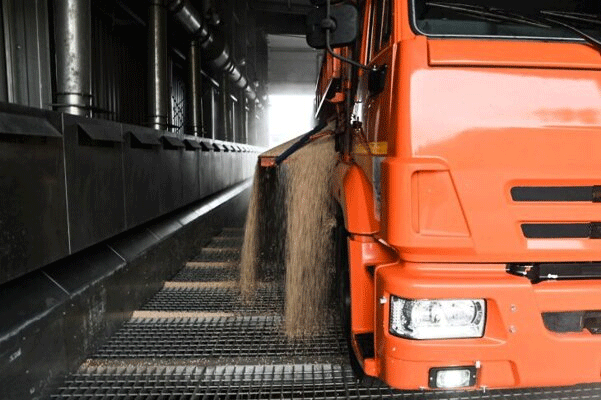
- Optimized Harvest Logistics: The agribusiness also focused on streamlining harvest and processing operations through automation and high-tech machinery, significantly reducing post-harvest losses and operational costs.
Contextualizing the Achievement
This yield of 8 t/ha is exceptional for a risky farming zone. For comparison, the USDA’s 2024 forecast for the average wheat yield in the European Union is around 5.8 t/ha, while in the major grain-producing regions of Russia, averages often range from 2.5 to 3.5 t/ha. A 2023 study in Nature Food emphasized that closing the “yield gap” in such regions is critical for global food security and is primarily achievable through the very technologies deployed by Ishimsky Agrokholding—improved genetics, precision nutrient management, and sustainable intensification practices.
The record set by Ishimsky Agrokholding is more than a local success story; it is a powerful testament to the potential of strategic agricultural innovation. It proves that high productivity is attainable even in challenging environments through a committed investment in precision farming, tailored genetics, and integrated technology. For farmers, agronomists, and farm owners, this case provides a compelling model for increasing profitability and resilience. For scientists and engineers, it underscores the real-world impact of developing and implementing adaptive agricultural solutions, highlighting a clear path forward for enhancing yields in risk-prone agricultural regions worldwide.
Error