

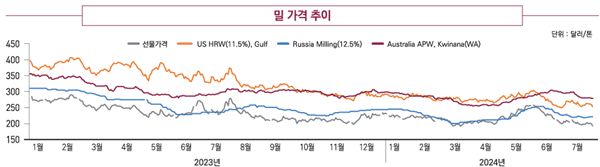
According to a recent report from the Korea Rural Economic Institute (KREI), key international grain futures prices dropped in July 2024, signaling a broader decline that is expected to persist through the third quarter. This trend is largely attributed to strong crop growth in major grain-producing regions and a significant increase in global ending stocks compared to the previous month.
For wheat, July futures prices fell by 9.0% compared to the previous month and a substantial 19.5% year-over-year, settling at $200 per metric ton. The decline is largely due to increased production forecasts in the United States and Russia, which are anticipated to boost global wheat supplies.
Despite geopolitical tensions, such as Russia’s refusal to extend the Black Sea grain deal and attacks on key Ukrainian export infrastructure, wheat prices have continued to drop. Russian milling wheat prices fell by 8.0% from the previous month, reaching $221 per metric ton. In the U.S., hard red winter wheat prices dropped by 1.6% to $261 per metric ton, while Australian premium wheat, benefiting from improved weather conditions, saw a 3.9% decline to $287 per metric ton.
Global Production and Consumption Trends
Looking ahead to the 2024/25 season, global wheat production is expected to rise by 0.7% compared to last month, reaching 1,081 million metric tons. This increase is primarily driven by higher yields in the U.S., Russia, and Canada. However, wheat consumption is projected to see a slight decrease of 0.4% year-over-year, mainly due to reduced demand in China, although a 0.2% increase from last month is expected due to higher consumption in the U.S. and Canada.
For other key crops like corn and soybeans, the production outlook is mixed. Corn production is forecasted to increase slightly by 0.3% compared to the previous month, but still reflects a 0.6% decline year-over-year, with total output estimated at 773 million metric tons. Conversely, global soybean production is expected to surge by 8.1% year-over-year, despite a minor monthly decrease, driven by expanded planting areas in major producing countries. Soybean consumption is projected to rise by 4.4% year-over-year, reaching 405.52 million metric tons.
Rice, another staple crop, is also expected to see modest increases in both production and consumption globally.
Implications for Farmers and Agronomists
The ongoing decline in grain prices has significant implications for the agricultural sector. For farmers, lower prices may result in reduced revenue, particularly for those who are heavily reliant on wheat, corn, or soybean sales. However, these price trends also create opportunities for cost savings, particularly in regions that rely on imported grains for animal feed or food production.
Additionally, the falling grain import price index is expected to benefit grain-importing countries, with food grain prices anticipated to decrease by 3.4% compared to the previous quarter and by 8.7% year-over-year. Feed grain prices are also expected to drop by 5.8% from the previous quarter and by a notable 16.4% year-over-year.
As global grain prices continue their downward trajectory into the third quarter of 2024, the agricultural sector must navigate a complex landscape of opportunities and challenges. While lower prices may strain farm revenues, they also offer potential savings on imported grain. Farmers, agronomists, and agricultural engineers must remain vigilant, adapting their strategies to manage risk and capitalize on the evolving market conditions.
Error